Belgrade Pride 2026: Program and Demands Take Shape Six Weeks Out
With Pride Week set for August 31 to September 6 and the march on September 5, organizers have locked in their advocacy themes and a demand list that keeps the same-sex partnership law front and center.
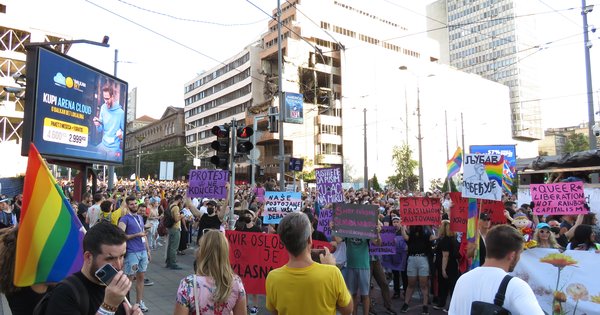
Belgrade Pride is now roughly six weeks out, and the shape of the 2026 edition is coming into focus. Pride Week runs Monday, August 31 through Sunday, September 6, with the Pride Protest March on Saturday, September 5, once again gathering and dispersing at Manjež Park in the center of the city. The community call for programming has closed, and organizers have said this year’s week will be built around a set of advocacy themes the LGBTI+ community itself flagged as its highest priorities.
For anyone who tracks the Western Balkans Pride calendar, Belgrade is one of the anchors. The march has gone ahead every year since 2014, after a decade in which attempts in 2001 and 2010 were met with violence severe enough to make the event effectively impossible. The 2014 return — held behind a wall of police — was the turning point. A decade on, the march regularly draws somewhere between 8,000 and 10,000 people, along with a visible international presence from embassies and, more grudgingly, cooperation from the Serbian state.
The demands haven’t moved — and that’s the point
The most striking thing about Belgrade Pride 2026 is how familiar the demand list is. At the top, again, is the adoption of the Law on Same-Sex Partnerships, a piece of legislation that has been drafted, praised, promised, and shelved more times than most activists care to count. A version was reportedly ready for consideration years ago, and successive governments have found reasons not to bring it forward. Serbia recognizes no legal partnership for same-sex couples, which means no next-of-kin rights, no shared property protections, no automatic say in a partner’s medical care.
Alongside it sits a demand for a Gender Identity Law and concrete improvements to healthcare for transgender people, whose access to gender-affirming care in Serbia remains patchy, slow, and dependent on a small number of providers. The list also presses for prompt and adequate responses from state authorities — and public condemnation from officials — when hate speech and hate-motivated crimes target the community; the adoption of local action plans for LGBTI+ residents; education for young people about sexual orientation and gender identity; and free, genuinely accessible PrEP and PEP.
There is one more demand that speaks to how long this fight has been going: an official apology to every citizen of Serbia who was prosecuted before 1994 for their sexual orientation or gender identity. Same-sex intimacy was decriminalized in Serbia that year. More than three decades later, the people criminalized under the old law have never been formally acknowledged, let alone cleared.
Why the repetition matters
It would be easy to read an unchanged demand list as a sign of stagnation. It’s more useful to read it as leverage. Serbia is a candidate for European Union membership, and the treatment of LGBTI+ people is one of the areas Brussels watches closely under the rule-of-law and fundamental-rights chapters of accession. Every year the partnership law goes unpassed is another year the gap between Serbia’s stated European ambitions and its statute books stays visible in official EU reporting. Belgrade Pride keeps the demand on the record precisely because the record matters.
The domestic backdrop this year is heavier than usual. Serbia has been living through months of large-scale protest since the deadly collapse of a railway station canopy in Novi Sad, and student-led demonstrations have reshaped the political mood across the country. Pride organizers have consistently framed LGBTI+ rights as part of the same broader demand for a state that is accountable to its citizens rather than to its own convenience — a framing that has drawn the community into wider solidarity, and occasionally into wider risk.
What to expect on the ground
For visitors, the practical picture is largely what it has been in recent years. The march itself is heavily policed and, in central Belgrade, has passed off without major incident for several years running. Pride Week’s cultural side — panels, exhibitions, film screenings, performances, and sport — spreads across venues in the city and tends to be where the community actually gathers and breathes, away from the security perimeter of the march.
If you’re planning to attend, the usual Balkans advice applies: the organized events and the central march are the safe, visible core, and it pays to be a little more aware in the hours before and after, and away from the crowd. Belgrade’s queer nightlife is real but discreet, clustered in a handful of bars and clubs rather than a marked-out district.
Six weeks out, none of the big legislative asks has been granted. But Belgrade Pride has never depended on winning in order to matter. Its value has always been in the showing up — thousands of people walking through the middle of a capital that spent a decade telling them they couldn’t, with a list of demands that refuses to get shorter until someone finally acts on it.
Belgrade Pride Week runs August 31 to September 6, 2026, with the Pride Protest March on Saturday, September 5. Program details are published by the organizers at prajd.rs.
Sources: Belgrade Pride (prajd.rs), Belgrade Pride — Demands, RFE/RL: ‘Equal And Loud’: Pride Marchers In Belgrade, Balkan Insight — LGBTIQ coverage