Eurovision 2026: Finland Wins in Vienna as the Flag Policy Gets Its First Real Test
Linda Lampenius and Pete Parkkonen took the trophy with Liekinheitin. The EBU's controversial flag rule — performers limited to the national flag, audiences allowed Pride and Palestinian flags — survived the night, but the optics tell a more complicated story.
Finland won the 70th Eurovision Song Contest tonight in Vienna. Linda Lampenius and Pete Parkkonen — a classical violinist and a pop star — closed out a long, loud Saturday at the Wiener Stadthalle with “Liekinheitin,” outpacing 24 other entries to take the trophy. Austria, defending champion JJ’s home turf after his win last year with “Wasted Love,” put on a show that was technically immaculate, politically nervous, and — for a contest whose entire mythology runs on queerness — strangely cautious about saying so out loud.
That caution is the story.
The flag rule, in plain language
In April, the European Broadcasting Union announced that performers and their delegations would be limited to one flag — the national flag of the country they represent — anywhere on the official stage, the Green Room, the Eurovision Village stage, or the Turquoise Carpet at the opening. No Pride flags. No solidarity flags. No regional flags. The stated reason was a tightening of Austrian fire-safety rules following the deadly Crans-Montana incident, plus what the EBU called the need to keep delegations from being drawn into political crossfire.
A few weeks later, ORF — the Austrian host broadcaster — clarified that audience members would face no such restriction. Pride flags in the crowd: fine. Palestinian flags in the crowd: fine. Any flag the venue’s fire-safety screening would allow through the door: fine. The compromise was hammered out under pressure from delegations and LGBTQ+ groups including ILGA-Europe, COC Nederland, and Outright International, several of whom called the original ban “ridiculous” and compared it to banning people from holding hands.
In Vienna tonight, both halves of the policy played out exactly as written.
On stage
There was no Pride flag visible on the main stage during any of the 25 finalist performances. JJ, opening the show with last year’s winner, wore an outfit that did almost as much work as a flag — a sequined corset-inspired top that nobody was going to mistake for straight men’s eveningwear — but the rules held. Several of the openly LGBTQ+ artists in this year’s field stuck strictly to their national flags during the staging and the postcards.
What was visible: every act used the freedom the rule technically allowed, which was to lean on national colors that overlapped with rainbow imagery whenever they could. The Finnish staging was awash in red, orange, and white pyrotechnics. The Spanish entry used a color wash that read pink-purple-gold to anyone who has ever stood near a bi flag. Workarounds, in other words. Not protest. Not silence either.
In the crowd
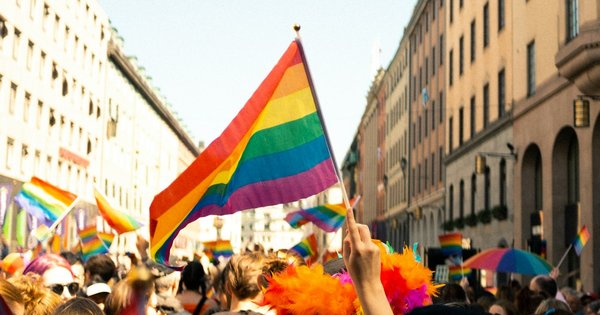
The audience response was the louder of the two answers tonight. Wiener Stadthalle is a 16,000-seat arena, and the broadcast camera kept catching Pride flags — the six-stripe rainbow, the trans flag, the bi flag, a few intersex-inclusive Progress Pride flags — held up by spectators throughout the four-hour show. Palestinian flags were also visible in the stands. ORF, true to its word, did not edit them out. The pre-show queue along Roland-Rainer-Platz looked, from photos posted by attendees throughout the afternoon, like a small Pride march.
The Eurovision Village in the city center had been similarly unrestrained for the entire fortnight of run-up events. Vienna’s queer venues — Why Not, Mango Bar, Cafe Savoy, Felixx — ran wall-to-wall watch parties. The week’s unofficial queer programming, including “Queers in the Garden” and a dozen smaller side events, drew crowds larger than several of the official fan zones.
The contest is still queer. The contest’s organizers spent the last six weeks trying to convince everyone that this was about safety. The audience answered by bringing flags anyway.
What the rule actually changed
The harder question is whether the new flag policy materially changed anything beyond the optics. On the evidence of tonight: not much for the audience, quite a lot for the artists.
For audiences, the EBU lost the PR battle and then handed back the ground it had tried to take. For artists, the precedent matters. Eurovision has been a stage where queer performers — Conchita Wurst in 2014, Loreen, Bilal Hassani, Marcus and Martinus, JJ himself — have used pride flags as part of their visual vocabulary, sometimes draped over shoulders, sometimes worn, sometimes literally waved during the reprise of the winning song. That gesture is now gone from the stage by rule. It is not gone from the building, but it is gone from the part of the building that the international broadcast sees live.
Whether that’s worth what the EBU got in exchange — fewer delegations being pressured to display, or not display, flags representing political positions of varying intensities — is the conversation that will continue past Sunday morning. The Israeli delegation’s situation, which sat under all of this, did not produce the on-stage incidents organizers were clearly trying to avoid. That is presumably the EBU’s win.
Finland, briefly
About the actual winners: “Liekinheitin” — “flamethrower” — is not subtle. It is also not particularly explicitly queer, though Lampenius and Parkkonen both have long records of LGBTQ+ allyship, and the song’s staging features dancers across the gender presentation spectrum. The duo took the contest after strong showings in both the jury vote and televote. JJ, performing his hosting reprise of “Wasted Love,” got the loudest sustained reaction of the night.
Eurovision 2027 is set for Finland.
Looking forward
For LGBTQ+ Europe, the immediate question is whether the EBU revisits the policy ahead of next year. Several delegations — including the Dutch, who have been the most public about their displeasure — have signaled they will push for either a full reversal or a clearer carve-out for Pride flags. The EBU has not committed to anything publicly.
For Austria, tonight ends what has been the queerest fortnight in Vienna’s recent calendar. WorldPride lands in Amsterdam in July, and EuroPride travels through several cities later in the summer. The contest itself, for one more year, remains the largest LGBTQ+-coded televised event in the world — even when the rules try to pretend otherwise.