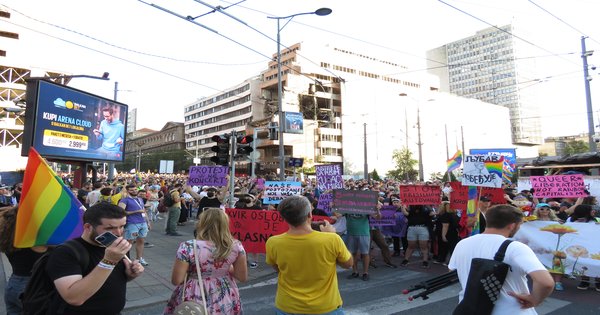
Brussels Goes All-In on Pride Month — and the Backlash Is Already Here
EU institutions launched a synchronized pro-LGBTQ+ campaign ahead of Pride Month, promoting the new 2026-2030 Equality Strategy. Supporters and critics agree on one thing: it is unusually coordinated.
In the days around the International Day Against Homophobia, Biphobia and Transphobia on May 17, something happened across the European Union’s official social media accounts that does not usually happen: they all said the same thing at the same time.
The European Commission, the European Parliament, and a string of senior EU officials published closely coordinated posts promoting LGBTQ+ equality and the bloc’s new LGBTIQ+ Equality Strategy 2026-2030. The messaging was near-identical across platforms and accounts — a level of synchronization that, whatever you think of the content, is a deliberate political choice. Heading into Pride Month, Brussels has decided to be loud.
What the campaign is actually promoting
The campaign is the public-facing layer of the EU’s second LGBTIQ+ equality strategy, which the Commission published in late 2025 to run through 2030. It succeeds the 2020-2025 strategy and is built around three stated pillars: protection, support, and social engagement.
In practice, the strategy commits the EU to a set of goals that are easy to list and much harder to deliver. It aims to embed LGBTQ+ equality across all areas of EU policy — not only fundamental rights, but education, employment, security, and healthcare. It promises stronger action against hate crime and hate speech. It pushes for better legal recognition for trans and non-binary people, including smoother cross-border recognition of gender and family status. And it backs the idea of a Europe-wide ban on so-called conversion practices.
It is worth being precise about what an EU strategy is and is not. It is not a law. The Commission cannot, by strategy document, legalize marriage in Poland or ban conversion therapy in Italy — most of the levers that matter for LGBTQ+ people sit with national governments. What a strategy does is set the Commission’s own priorities, shape which proposals get drafted, and create a yardstick advocates can hold institutions to. Its force is agenda-setting, not legislation.
Why the coordination matters
The synchronized rollout is a signal aimed in two directions at once.
The first audience is national governments that have spent recent years moving the other way — Hungary above all, where the Court of Justice of the EU ruled in April 2026 that the country’s “child protection” law restricting LGBTQ+ content breaches core EU values. By making Pride Month an institution-wide message rather than a hashtag from a single directorate, the Commission is putting its own credibility behind the position that LGBTQ+ rights are not a niche file but part of the EU’s basic value framework.
The second audience is LGBTQ+ Europeans themselves, in a year when the data is grim. The EU Fundamental Rights Agency’s most recent survey found that more than half of LGBTIQ people — 55 percent — reported hate-motivated harassment, up 18 percentage points since 2019. A coordinated campaign is, in part, a response to people who have been asking the institutions to be visible when it is uncomfortable, not only when it is easy.
The backlash
The backlash arrived almost immediately, and it is worth reporting fairly because it will shape the rest of the year.
Conservative commentators and outlets aligned with national-conservative governments — the Hungarian government’s media ecosystem prominent among them — have framed the campaign as evidence that Brussels is using its institutional megaphone to push ideological activism rather than neutral governance. The argument, made in good faith by people who hold it, runs roughly like this: family and morality policy is a national competence under the EU treaties; an EU-wide values campaign on a contested social question blurs that line; and a synchronized push across supposedly independent institutions looks less like communication and more like orchestration.
There is a coherent version of that objection and it deserves to be stated rather than waved away. It is also contested on its own terms. Supporters of the campaign point out that non-discrimination is not a fringe value smuggled into the treaties but is written into Article 2 of the Treaty on European Union and the Charter of Fundamental Rights, and that the CJEU’s Hungary ruling settled — at least as a matter of EU law — that LGBTQ+ equality falls inside the EU’s value framework rather than outside it. On that reading, the institutions are not inventing a competence; they are defending one a court has already affirmed.
Is the strategy strong enough?
Notably, some of the sharpest criticism has come not from opponents of LGBTQ+ rights but from advocates. ILGA-Europe, the continent’s largest LGBTQ+ rights network, welcomed the new strategy while openly questioning whether it is “fit for purpose” — arguing that ambition on paper means little without enforcement, binding measures, and budget lines attached to the goals.
That is the honest tension of this Pride Month in Brussels. The EU has produced its most coordinated pro-LGBTQ+ messaging in years. Whether 2030 looks different from 2026 depends on what the institutions do in the quieter months, after the campaign graphics come down — on the legislative proposals, the infringement cases, and the money. A strategy is a promise. The next four years are the test.