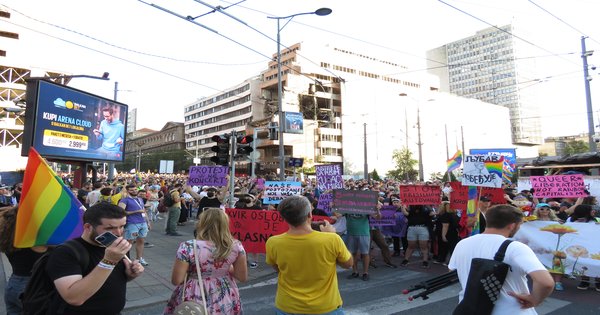
Albania Opens Cluster 5 of EU Accession — But the LGBTQ+ Gaps in Cluster 1 Aren't Fixed
Albania has cleared the interim benchmarks on rule of law and fundamental rights, accelerating EU negotiations. The country still has no legal recognition of same-sex couples, and the Discrimination Commissioner post sits vacant.
Albania’s EU membership bid has shifted into a faster gear. The country opened negotiations on Cluster 5 — economic policy, internal market, and competition — in November 2025, and finalized the 24 interim benchmarks under Chapters 23 and 24 (judiciary, fundamental rights, justice, freedom and security) in January 2026. Tirana has set a target of closing all chapters by 2027. By Western Balkans standards, this is genuinely fast.
What it is not, however, is a finished story for LGBTQ+ Albanians. The Cluster 1 fundamentals chapters that drove the headlines in January are exactly the chapters that determine how the EU treats LGBTQ+ rights as accession criteria — and several of the unresolved gaps have nothing to do with technical benchmarks. They are political choices the Albanian government keeps deferring.
What Albania actually has
Albania’s legal framework on paper is stronger than its public reputation suggests. The 2010 Law on Protection from Discrimination, amended in 2020, explicitly covers gender identity, sexual orientation, sex characteristics, and HIV status. Anti-discrimination protections cover employment, education, healthcare, and the provision of goods and services. Hate-motivated violence based on sexual orientation or gender identity is a recognized aggravating factor in criminal law. The 2024 Gender Equality Law extended protections further.
For comparison, neither Romania nor Bulgaria — both EU member states — has anti-discrimination protections of comparable breadth on gender identity.
What Albania doesn’t have
There is no legal recognition of same-sex partnerships of any kind. No civil unions, no registered cohabitation, no marriage. Same-sex couples in Albania have no legal pathway to property rights, hospital visitation, inheritance, or family reunification under domestic law. Couples who marry in countries that recognize them — and there are now hundreds of Albanian binational gay couples in this position across the EU — have no recognition when they return.
There is no legal gender recognition framework. Trans Albanians cannot change their legal sex. There is no joint adoption right for same-sex couples and no access to assisted reproductive technologies for LGBTQ+ individuals.
And the Commissioner for Protection from Discrimination — the office that exists specifically to enforce the protections Albania already has — has been vacant since 2023. The UN Human Rights Committee flagged this in its concluding observations, calling the continuous postponement of the appointment a serious institutional failure. Two and a half years on, no appointment has been made.
Why this matters for accession
The European Commission’s progress reports track LGBTQ+ rights under Chapter 23 (Judiciary and Fundamental Rights). Closing Cluster 1 means demonstrating not just that anti-discrimination laws exist, but that they are implemented and enforced — which is hard to do when the dedicated enforcement body is leaderless.
Western Balkans accession is also where the EU’s LGBTQ+ Equality Strategy 2026-2030, adopted by the Commission in October 2025, gets stress-tested. The strategy commits the Commission to addressing hate crime, conversion practices, and family rights including across borders. Candidate countries will be assessed against the standard — and family rights without partnership recognition is a contradiction.
This is also where the EU’s recent record matters. The Court of Justice’s April 21 ruling against Hungary’s anti-LGBTQ+ propaganda law established that targeting LGBTQ+ people violates the “very identity” of the Union under Article 2 of the Treaty on European Union. Future candidate countries will be judged by the same article. Albania has not adopted laws like Hungary’s — it has done the opposite. But the absence of harm is not the presence of recognition.
The political reality
Albanian political leadership across parties has been consistently friendly to LGBTQ+ communities at the rhetorical level. Tirana Pride has been held annually since 2014 with police protection and frequent participation by foreign embassies. Government ministers attend. Prime Minister Edi Rama has publicly supported civil partnerships in interviews going back to 2017. The country ranks higher on most LGBTQ+ rights indices than several EU member states.
What has not happened is legislation. A draft civil partnership bill has been “in development” for years. It has never reached parliament. The standard explanation — that the Albanian public is not ready, that Orthodox and Muslim conservative voices would resist — is true and also a choice. Public support for same-sex partnerships in Albania has been growing in survey data, particularly among younger and urban respondents.
The EU accession framework gives Albanian advocates a lever they have never had before: external pressure aligned with domestic preferences. ERA-LGBTI, the Western Balkans equality network, opened a fresh round of project funding for the region in April 2026 specifically to support advocacy in candidate countries. Pink Embassy and Streha continue running the largest Albanian-language LGBTQ+ legal aid services in the country.
The accession train is moving. The question is whether Albanian LGBTQ+ communities will be moved with it — or asked to wait, again, for a more convenient moment.