Albania Just Passed a Gender Equality Law That Quietly Protects LGBTQ+ People
Albania's new gender equality law includes protections for sexual orientation, gender identity, and gender expression — a landmark for the Balkans. But the fight to keep inclusive language in the law was anything but smooth.
We’ve been living in Tirana on and off for over four years now, and we’ve watched Albania’s relationship with LGBTQ+ rights evolve in real time — sometimes agonizingly slowly, sometimes with surprising bursts of progress. The passage of the new Law on Gender Equality late last year was one of those bursts.
On the surface, it’s a gender equality law. It introduces quotas requiring women to hold 30 to 50 percent of positions in government bodies, from parliament to the diplomatic service. But woven into the text is something much more significant for LGBTQ+ Albanians: explicit protections against discrimination based on sexual orientation, gender identity, and gender expression.
That language didn’t get there easily.
What the Law Actually Does
Albania’s parliament adopted the law in November 2025, replacing an older framework that had been praised in principle but rarely enforced in practice. The new version aligns Albania’s legal framework with EU gender equality standards — a critical step as the country pushes toward EU accession.
For LGBTQ+ people specifically, the law prohibits discrimination based on gender, gender identity, and sexual characteristics. It’s not a marriage equality bill or a civil unions law, but it reinforces a legal floor: you cannot be discriminated against in employment, education, healthcare, or public services because of who you are.
That matters in a country where, according to a 2024 report from the UN Office of the High Commissioner for Human Rights, LGBTQ+ people still face widespread discrimination in daily life — from being denied housing to being turned away by healthcare providers.
The Fight Behind the Scenes
The law almost looked very different. In the weeks leading up to the vote, Albania’s ruling Socialist Party floated amendments that would have stripped the law of key terms including “diversity,” “intersectional discrimination,” and “gender stereotypes.” Trans Europe and Central Asia (TGEU) raised the alarm, warning that the removals would contradict EU human rights standards and undermine the law’s purpose.
Even more alarming was a proposed amendment to the Civil Registry Act that would have defined sex as “biologically immutable” — effectively banning legal gender recognition for trans people and erasing the legal pathway for changing gender markers on official documents.
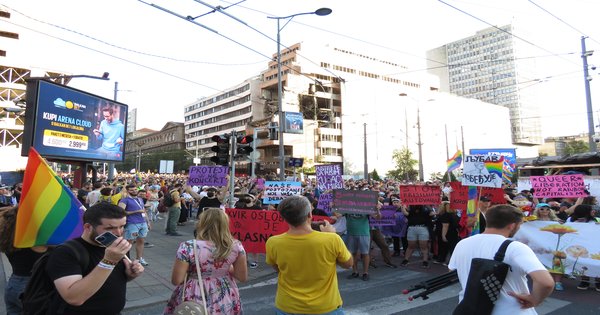
Civil society pushed back hard. Albanian LGBTQ+ organizations, backed by international advocacy groups, mounted a unified campaign. The proposed Civil Registry amendment was ultimately withdrawn by the Socialist Party, and the inclusive provisions in the gender equality law were maintained.
Why This Matters for the Balkans
Albania already had anti-discrimination protections on the books — a 2010 law banned discrimination based on sexual orientation and gender identity across employment, education, healthcare, and housing. But the gap between law and lived reality has always been wide. What makes the gender equality law significant is its connection to EU accession.
The European Commission’s Commissioner for Enlargement, Marta Kos, welcomed the law, noting that “gender equality and non-discrimination are an integral part of EU law.” For Albania, every piece of legislation that aligns with EU standards is a concrete step toward membership — and that creates a political incentive to protect, rather than erode, LGBTQ+ rights.
This is a pattern we’ve seen across the Western Balkans: EU accession functions as both a carrot and a framework. Montenegro legalized civil partnerships partly as a signal to Brussels. Kosovo’s government has discussed civil unions in the same breath as its European aspirations. Albania’s gender equality law fits squarely into this dynamic.
The Reality on the Ground
We want to be honest about what this law does and doesn’t change in daily life. Tirana has a small but visible queer community. There are spaces where we feel comfortable, people who are openly living their lives, organizations doing critical work. But Albania is also a country where most LGBTQ+ people are not out to their families, where hate speech circulates freely online, and where anti-gender disinformation campaigns — often imported from Russia and amplified by local religious and political figures — are growing more aggressive.
A law on paper doesn’t change that overnight. But it does change the terms of the argument. When the government passes legislation that explicitly names gender identity and sexual orientation as protected categories, it becomes harder — legally and politically — to argue that LGBTQ+ people don’t deserve protection.
We’ve been here long enough to know that progress in the Balkans isn’t linear. It comes in fits and starts, with setbacks that can feel devastating. But Albania’s gender equality law, with its hard-won inclusive language, is a genuine step forward — and it’s one that deserves more attention than it’s gotten.