Albania's Gender Equality Law Faces a Referendum Push — But the Constitution May Block It
A conservative coalition is collecting signatures to repeal Albania's six-month-old gender equality law. The country's constitution may make that legally impossible — but the political damage is already happening.

Albania’s Law on Gender Equality — passed by Parliament on November 7, 2025, and praised by ILGA-Europe this week as one of the year’s bigger upward moves in the Balkans — is now facing an organized effort to repeal it. The push isn’t coming from Parliament. It’s coming through a referendum mechanism that, on paper, may not actually be available for this kind of law.
What the law does
Law no. 64/2025 was the most consequential piece of LGBTQ-relevant legislation Albania has passed in years. It strengthens existing protections by explicitly prohibiting “any less favorable treatment of a person on the grounds of sex, sexual orientation, gender identity, expression of gender identity or sex characteristics,” as well as “intersectional discrimination” — meaning combined forms of discrimination targeting people who fall into multiple protected categories.
For trans Albanians, the inclusion of “gender identity,” “gender expression,” and “sex characteristics” in statute was new. Before this law, Albania’s anti-discrimination framework relied on a 2010 statute that had been amended piecemeal, with trans-specific protections inferred rather than written in. The 2025 law made those protections explicit and added enforcement teeth.
It was also part of Albania’s EU accession workstream — the kind of legislative alignment Brussels asks for from candidate countries on the Cluster 1 (fundamentals) chapters.
Who is trying to repeal it
On December 30, 2025, three groups filed a complaint with Albania’s Constitutional Court: the Conservative Center’s “Pro Family and Life Coalition,” the Muslim Forum of Albania, and Diaspora for a Free Albania. They asked the court to suspend the law, declare it unconstitutional, and either fully or partially repeal it.
On January 12, 2026, the State Election Commissioner approved a separate request from the same coalition: a form for collecting signatures to trigger a general referendum to repeal the law. That signature-gathering effort is the one currently in progress.
Their public framing has been familiar — “protecting the family,” objections to the term “gender identity,” and claims that the law smuggles “ideology” into Albanian statute. There has been no organized argument that the law’s anti-discrimination provisions themselves are flawed, only that they shouldn’t exist.
Why the constitution may block this
Albania’s constitution contains a provision that’s about to become highly relevant: Article 151(2) prohibits referendums that restrict fundamental human rights and freedoms.
That’s not a small caveat. The Law on Gender Equality is, in its own text, a law that expands protection from discrimination — meaning a referendum to repeal it would, by definition, reduce the level of human rights protection in Albania. Constitutional law scholars at the University of Tirana and at Citizens.al have argued publicly that this puts the proposed referendum squarely in the category Article 151(2) was designed to exclude.
The Constitutional Court hasn’t yet ruled on whether the referendum is permissible. If it does rule before signature collection completes, the entire effort could be stopped procedurally. If it rules after — or doesn’t rule in time — Albania could end up with a referendum that proceeds, gets repealed by the court afterward, and damages the law’s standing politically even if it never becomes binding.
This is the scenario activists in Tirana are most worried about. A failed referendum still has an effect: it sends a signal to police, prosecutors, and lower courts that the law is contested, that enforcement is optional, that the public mood is hostile.
What this means for EU accession
Albania is in active accession negotiations. The EU has explicitly tied progress on the Cluster 1 fundamentals — rule of law, fundamental rights, judicial independence — to formal opening and closing of other clusters. The Law on Gender Equality was a Cluster 1 deliverable.
If the law is repealed or substantially weakened by referendum, the European Commission’s annual country report would have to note it. Brussels has been clear, both before and after the 2026 Rainbow Map dropped on May 12, that backsliding on anti-discrimination protections is treated as a fundamentals issue, not a soft preference.
The Albanian government — led by the Socialist Party, which sponsored the original law — has publicly committed to defending it. But the political calculus shifts if the referendum gains traction. Albania holds elections in 2027.
What happens next
Three things to watch over the next two months:
Signature verification. The coalition needs 50,000 valid signatures to trigger the referendum. The State Election Commissioner will verify them.
The Constitutional Court ruling. If it comes before the signature count is certified, it could end the matter quickly. If it comes after, the politics get messier.
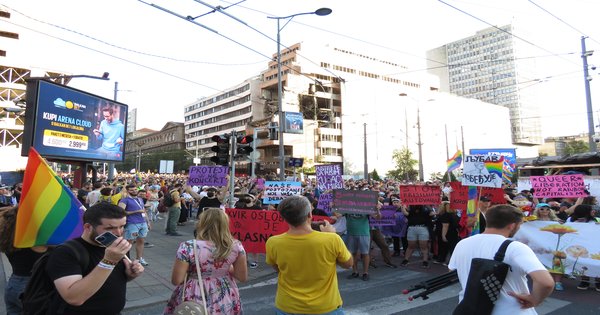
Tirana Pride on May 23. This year’s march is happening exactly 10 days from now, with the referendum push as its political backdrop. Pink Embassy/LGBTI Pro Albania, which organizes the event, has built much of its 2026 messaging around the law and the threat to it. Expect the march to be larger, louder, and more directly political than it’s been in years past.
The law that ILGA-Europe credited this week with moving Albania up in the Rainbow Map is now the same law being contested in court and at the petition table. Whether it survives in its current form will probably be settled before the end of 2026.