The Weapon Aimed at LGBTQ+ Activists in the Balkans Is Disinformation
Across the Western Balkans, a coordinated anti-gender movement is using online disinformation to silence LGBTQ+ advocates and feminists. We're watching it from Tirana — and it's working.
We’re writing this from Tirana, where we’ve been based for the better part of four years. We watch Albanian politics and society closely — not just as observers, but as people who have chosen to build our lives here. And what we’ve been watching over the past several months has been, frankly, alarming.
Not alarming in the way that makes it easy to write about. There are no dramatic legislative attacks on LGBTQ+ rights in Albania right now. No new bans, no conversion therapy bills, no executive orders. Albania is, by regional standards, actually doing reasonably well — 26th on the ILGA-Europe Rainbow Map, with anti-discrimination protections that predate most of its neighbors’.
The alarming thing is subtler, and in many ways more insidious: a coordinated campaign of online disinformation targeting LGBTQ+ activists and feminist organizers. And it’s playing out across the entire Western Balkans region, not just here.
What Happened Around International Women’s Day
Between February and early March 2026, monitors from the Balkan Investigative Reporting Network documented a wave of digital rights violations targeting women across the Western Balkans — especially around International Women’s Day on March 8.
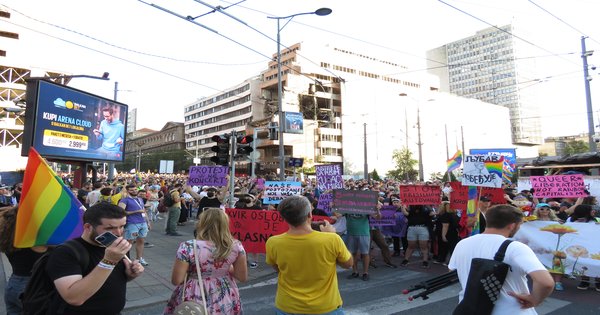
In Albania, online outlets spread false claims about the organizers of the March 8 rally in Tirana. The disinformation framed the protest as a foreign-funded operation, questioned the identity and motives of organizers, and lumped together feminists and LGBTQ+ activists as part of a coordinated attack on “Albanian values.”
The effect was immediate. Hundreds of comments containing gender-based and homophobic hate speech flooded social media. The organizers — women who had simply planned a public march — were doxxed, threatened, and mocked. The goal, clearly, was not debate. It was intimidation.
This is a pattern researchers and advocates have been documenting across the region for years. It accelerated in 2025, and it appears to be accelerating further in 2026.
Organized, Funded, and Coordinated
The German Marshall Fund and the Balkans Forward Foundation have both published detailed analyses of the anti-gender movement in the Western Balkans. Their findings are consistent: this is not spontaneous social conservatism. It is an organized political strategy, backed by religious actors and far-right networks, often with connections to foreign funding sources.
The movement’s two primary targets are education — specifically, attempts to introduce comprehensive sexuality education or gender equality content into schools — and public assembly, particularly Pride parades. The playbook is recognizable to anyone who has watched similar movements operate in Poland, Hungary, or Russia: identify a visible target, flood the information space with disinformation, amplify outrage through coordinated social media activity, and create an environment in which civil society organizers feel too exhausted and frightened to continue.
What makes the Balkans iteration particularly dangerous is the regional context. These are countries where democratic institutions are still fragile. Where the rule of law is inconsistently applied. Where civil society organizations have limited resources and even more limited legal protection. When a coordinated disinformation campaign targets an activist here, there is rarely the kind of institutional response — platform action, legal support, public solidarity from elected officials — that might blunt its impact.
Why This Matters Beyond the Balkans
We want to be careful not to overstate what’s happening. Albania is not Belarus. There’s no “propaganda law” waiting for Lukashenko’s signature. Tirana Pride is happening in seven weeks, and we’ll be there.
But disinformation works slowly, and it works by degrading the conditions in which advocacy is possible — before any formal law is passed. It drives people off platforms. It makes organizers think twice about using their real names. It creates an atmosphere of social risk around visible LGBTQ+ identity that doesn’t require any legislation to enforce.
The anti-gender movement in the Balkans has been explicit about its goals. It wants to stop the extension of legal rights to same-sex couples. It wants to prevent trans people from having legal recognition. It wants to remove gender equality content from schools. And increasingly, it has found that disinformation campaigns are a highly effective tool for creating the social climate in which those political goals become achievable.
What Activists Are Doing
The people doing this work in the Balkans — in Tirana, in Prishtina, in Belgrade, in Sarajevo — are doing it anyway. They’re showing up for IWD marches despite the harassment. They’re organizing Pride despite the threats. They’re building legal aid networks, documentation projects, and community support systems with often minimal resources.
BIRN’s ongoing monitoring project is part of the response: systematic documentation of digital rights violations creates a public record and makes it harder for disinformation campaigns to operate without accountability. The ERA-LGBTI network, which tracks policy and supports advocacy across the Balkans and Turkey, has been expanding its capacity for exactly this kind of documentation work.
The EU accession process is also a factor. Both Albania and several other Western Balkans countries are EU candidate states, and the European Commission has been increasingly explicit that human rights protections — including for LGBTQ+ people — are part of the accession criteria. That external pressure is real, even if it moves slowly.
We’re Watching
From where we sit in Tirana, the situation is genuinely mixed. Progress is real. So is the backlash. The question is which one moves faster — and how much support civil society here gets from the rest of the world while they’re doing this work.
We’ll keep watching. And writing about it.
Sources: Balkan Insight / BIRN • German Marshall Fund • Balkans Forward Foundation • ERA-LGBTI Balkans & Türkiye