Lukashenko Signs Belarus's Anti-LGBTQ+ 'Propaganda' Law. UN Experts Call It a 'Dangerous Escalation.'
The president put his signature to the Russian-style bill on April 15. Two days later, seven UN human rights experts issued a joint statement warning the law legitimizes persecution of an already marginalized community.

When the Belarusian parliament finalized its “LGBT propaganda” law on April 2, the open question was whether Alexander Lukashenko would actually sign it or let it sit — a common tactic when the Minsk regime wants international leverage without fully committing. That question was settled on April 15, when Lukashenko put his signature to the bill and made it law.
Two days later, on April 17, seven United Nations human rights experts issued a joint statement calling the law “a dangerous escalation” and warning that Belarus was now formally criminalizing human rights advocacy itself.
The Belarus law is a near-carbon-copy of Russia’s 2013 “gay propaganda” legislation, updated with the 2023 Russian amendments that expanded it to cover adults as well as minors. Its reach is broad enough to do what its authors intended: make LGBTQ+ life invisible, expensive to speak about, and legally risky to defend.
What the law actually prohibits
The statute bans the “propaganda of homosexual relations, gender reassignment, childlessness, and pedophilia.” The grouping is deliberate. By placing same-sex relationships alongside pedophilia in the same clause, the law legally conflates the two — a framing Russia pioneered and Belarus has now imported wholesale.
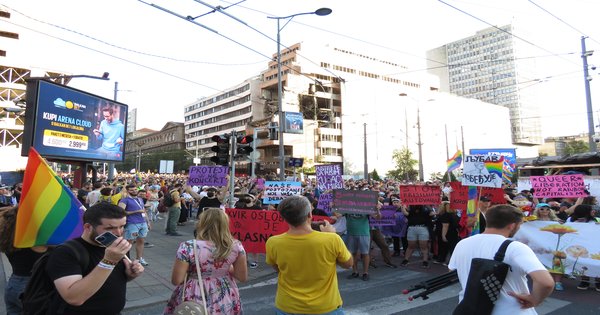
“Propaganda” is defined so vaguely that enforcement is effectively unlimited. The statute captures any “dissemination of appealing information intended to influence citizens’ perceptions.” That definition sweeps in social media posts, Pride flags, news coverage, educational materials, support group announcements, books, television, advertising, and — in practice — any public statement that treats LGBTQ+ people as fully human.
Penalties scale with who gets caught and what they published. Individuals face fines of up to 200 “basic units” — several thousand Belarusian rubles. Organizations face significantly larger fines and can lose their legal registration. First-time offenders may face community labor or up to 15 days of administrative detention. Repeat offenses can trigger criminal prosecution under related statutes on extremism and public order.
Childlessness is covered because the regime wants higher birth rates. Transgender visibility is covered because it’s unpopular with the base and cheap to target. LGBTQ+ visibility is covered because it always is.
The UN response
The statement issued on April 17 came from seven UN mandate-holders — independent human rights experts appointed by the Human Rights Council to monitor specific rights areas. Their text pulled no punches:
“By conflating human rights advocacy and information about sexual orientation, gender identity, and reproductive autonomy with administrative offences, the authorities are fuelling prejudice and legitimising discrimination against already marginalised groups and defenders of their rights.”
Another passage warned: “This law represents a dangerous escalation. It equates legitimate human rights advocacy with an administrative offence and risks further legitimising persecution.”
The experts also flagged the law’s practical effect on human rights defenders. Belarusian LGBTQ+ organizations and women’s rights groups have been operating under severe constraint since the 2020 protest crackdowns — many registered NGOs were forcibly dissolved in 2021 and 2022. The remaining civil society infrastructure is now built on informal networks, underground mutual aid, and cross-border coordination with exiled diasporas in Vilnius, Warsaw and Tbilisi. The new law makes even that informal work legally risky.
What it means for LGBTQ+ Belarusians right now
A 2024 community survey conducted by exiled Belarusian LGBTQ+ organizations found that 66 percent of queer Belarusians said they did not feel protected by the police. Only 14 percent of respondents who had experienced a discrimination incident reported it to the authorities. The new law will not improve those numbers. It was not designed to.
The immediate impact is likely to mirror what Russia experienced after 2013 and again after the 2023 expansion: a chilling effect across media, publishing and education; self-censorship by platforms worried about penalties; the collapse of visible LGBTQ+ spaces; and an uptick in private denunciations, because “propaganda” is vague enough that a neighbor, teacher or coworker can now credibly file a complaint about almost anything.
The secondary impact, over a longer horizon, is migration. Belarusian queer communities have already lost many of their most visible activists to exile since 2020. This law accelerates that departure — particularly for families with trans members, who now face legal risk for the children’s hormone prescriptions and for any school or medical documentation that acknowledges their identity.
The regional picture
Belarus is now the fifth European country with a Russia-style “LGBT propaganda” law on the books, joining Russia itself, Hungary (still in effect pending Tuesday’s ECJ ruling), Georgia, and Kyrgyzstan on the CIS periphery. Slovakia, Bulgaria and Romania have considered similar legislation in the past three years without passing it. The pattern is coherent: these are countries whose governments need a culturally cheap wedge issue, a distraction from economic fragility, and a gesture of alignment with Moscow’s social vision.
The Belarus law is, in that sense, fully expected. It arrives right on schedule for a regime whose relationship with the Kremlin deepened after 2020. What makes it noteworthy is not the surprise — there wasn’t any — but the velocity. The bill moved from first reading to presidential signature in under six months. In a functioning parliamentary system that might be normal. In Belarus it confirms that the regime wanted it, that Moscow wanted it, and that nobody inside the system was interested in slowing it down.
For LGBTQ+ Belarusians still in the country, the options have narrowed again. For the exiled community in Lithuania, Poland and Ukraine, there is more work to do. And for everyone trying to track how Russia-style “traditional values” legislation spreads across Eastern Europe, the new law is a data point worth bookmarking — because the next country considering a similar bill will point to Belarus as a precedent that survived its own UN condemnation.