A Bosnian Court Just Ruled That Milorad Dodik Personally Discriminated Against LGBTI People
The Basic Court in Banja Luka has found that the former Republika Srpska president's 2023 statements about LGBTI Bosnians created 'a hostile and offensive environment.' It's one of the first rulings in the region to hold a top politician personally accountable for discriminatory speech.

For the better part of two decades, Milorad Dodik said whatever he wanted about LGBTI Bosnians. He called for their “elimination” from public life. He told them to move to countries where their “lifestyles are normal.” He demanded that schoolbooks be purged of their existence and that the “networks” giving them visibility be regulated because, in his telling, they “polluted the public space.”
He did all of this while holding the highest elected office in Republika Srpska, one of the two political entities that make up Bosnia and Herzegovina. The statements carried the full weight of his office, and nobody in a position to stop him ever tried.
On March 16, 2026, a judge in his own capital told him he was not above the law.
The ruling
The Basic Court in Banja Luka — the main city of Republika Srpska and, until last year, the seat of Dodik’s presidency — ruled in favor of the Sarajevo Open Centre (SOC), the LGBTI rights organization that sued him in 2023 over a series of inflammatory public statements. The court found that Dodik’s comments about the LGBTI community constituted discrimination “on the grounds of sexual orientation, gender identity, and sex characteristics,” and that they had “created a hostile and offensive environment.”
Critically, the court did not treat Dodik as a private citizen exercising freedom of speech. It treated him as a head of a political entity whose words carried enforceable public authority. As lead counsel Dženana Hadžiomerović framed it: courts in Bosnia and Herzegovina “are increasingly clearly applying the principle that no politician, regardless of the position they hold, has an unlimited right to freedom of expression if such statements violate the right to equal treatment of LGBTI people or any other minority.”
The court also issued an injunction: Dodik is formally prohibited from making further statements of “the same or similar nature” that would violate the right to equal treatment of LGBTI people. Violating the order is itself actionable.
The statements at the center of the case
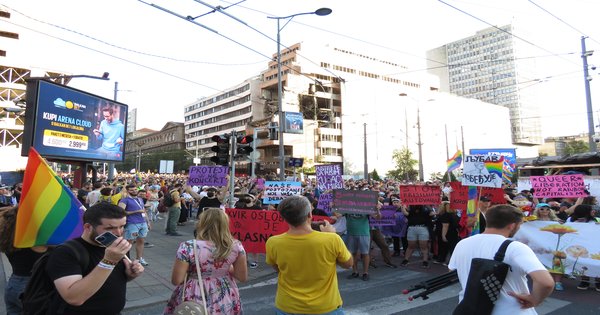
The specific conduct the court ruled on took place in March 2023, in the run-up to the first-ever Pride march planned for Banja Luka. In a series of public appearances and media interviews, Dodik issued what amounted to a coordinated campaign of delegitimization against the march’s organizers. He demanded that LGBTI activists be banned from schools. He called for “networks” that platformed them to be shut down. He suggested that LGBTI people relocate to “countries where such lifestyles are normal.”
Five days before the march was due to take place, on March 18, 2023, a group of masked men stormed a cafe in downtown Banja Luka where activists were holding a pre-Pride event. They beat attendees and an accompanying journalist, Vanja Stokić, with metal bars. Banja Luka police then banned the Pride march outright, citing “public safety.”
The March 2026 ruling does not directly attribute the violence to Dodik. But it does find — in a court of his own entity, under his own judiciary — that his rhetoric created the environment in which the violence occurred. SOC’s representative Darko Pandurević called the judgment “a symbolic but significant step forward, and a reminder that no one should be above the law.”
Why the timing matters
Dodik is no longer president of Republika Srpska. In February 2025, he was convicted of refusing to implement decisions by Bosnia’s international High Representative and sentenced to a year in prison and a six-year ban from political office. Bosnia’s Central Election Commission terminated his mandate in August 2025, and after losing his appeal, he eventually announced in September that he was stepping down. The court that just ruled against him is the same court system he spent years threatening to separate Republika Srpska from.
That context is not incidental. For most of Dodik’s 20-year political career, the effective rule of law in Republika Srpska was the rule of Dodik. Judges who crossed him were pushed out. Cases against him stalled. Civil society groups that relied on his entity’s cooperation — and Sarajevo Open Centre has worked in Banja Luka for over a decade — had to calibrate how publicly they challenged him, because direct confrontation carried real risks.
The 2026 ruling is the first time a court in Republika Srpska has formally held him personally accountable for harm done to LGBTI people, and it comes only after he was stripped of the power he used to harm them. The sequencing is itself a diagnostic: this is what LGBTI accountability looks like in the Western Balkans when the political ground finally shifts.
What it does and doesn’t change
This is a first-instance judgment. Dodik’s legal team can appeal, and given his history, they almost certainly will. The court did not impose a financial penalty — Bosnia’s anti-discrimination law allows for one but doesn’t mandate it — and the injunction has no automatic enforcement mechanism. If Dodik violates it, SOC will have to come back to court.
The ruling also lands in a Bosnia where LGBTI rights have moved slowly for years. The country’s anti-discrimination law has explicitly covered sexual orientation and gender identity since 2016, and in 2026 Bosnian courts have started to apply it: the Dodik ruling comes only weeks after a cantonal court in Sarajevo upheld the country’s first-ever conviction for anti-LGBTQ+ hate speech, against former parliamentarian Samra Ćosović Hajdarević. Two rulings, two months, both against politicians.
What it does change is the calculation for the next politician tempted to stand up in Banja Luka or Mostar or Sarajevo and say what Dodik said. The ceiling on that kind of speech has moved. It used to be: nothing happens. It is now: a lawsuit, a verdict, a published judgment with your name on it, and a court order telling you to stop. That’s not full accountability. But it’s closer than LGBTI Bosnians have ever gotten to it from inside Republika Srpska.
For a political entity whose first-ever Pride march was beaten up and banned on the same day, that is real progress. Not fast. Not finished. But real.