Bosnia Upholds Its First-Ever LGBTQ+ Hate Speech Conviction on Appeal
A cantonal court has upheld the conviction of a former MP who called for LGBTQ+ people to be 'isolated and kept away from children.' It took 13 years for Bosnia's anti-discrimination law to produce its first verdict on sexual orientation — and now that verdict has survived appeal.

In February 2026, a cantonal court in Sarajevo upheld Bosnia and Herzegovina’s first-ever conviction for anti-LGBTQ+ hate speech, fully affirming a lower court’s ruling against former parliamentarian Samra Ćosović Hajdarević. For a country where it took 13 years for the anti-discrimination law to produce its first verdict on sexual orientation, the appeal ruling is not just a legal milestone. It’s proof that the first one wasn’t a fluke.
The case traces back to 2019. When organizers announced plans for Sarajevo’s first Pride march, Ćosović Hajdarević — then a member of parliament for the SDA party — posted a statement on Facebook that went viral. She called the planned march an attempt to “destroy” the state and its people. “I want people like this to be isolated and kept away from our children and society,” she wrote. “Let them go somewhere else and make a city, a state, and a law for themselves and their own rights that no one will dispute.”
It was not subtle. And it was not ignored.
The First Verdict
Activists from the Sarajevo Open Centre filed a discrimination claim against Ćosović Hajdarević. The case wound through the courts for years. When the Municipal Court of Sarajevo finally ruled on it, the decision was historic: the former MP was found to have violated the right to equal treatment of LGBTIQ+ people on the basis of sexual orientation, gender identity, and sexual characteristics.
She was ordered to refrain from repeating the statements, to publish the judgment in two newspapers, and to pay court costs. It was the first time in Bosnia’s history — despite the anti-discrimination law being on the books since 2009 — that a court formally recognized discrimination against LGBTQ+ people.
The Sarajevo Open Centre called it a “significant step forward in the protection of human rights.” They weren’t overstating it. In a country where political leaders routinely use anti-LGBTQ+ rhetoric without consequence, the ruling drew a line.
What the Appeal Means
The appeal ruling in February 2026 matters for a specific reason: it removes the asterisk. A single lower court decision can always be dismissed as an outlier, an anomaly, a judge’s personal politics. An appellate court affirming that decision establishes it as precedent. The legal principle — that public anti-LGBTQ+ hate speech constitutes discrimination under Bosnian law — is now tested and upheld.
For the Sarajevo Open Centre and the broader LGBTQ+ community in Bosnia, the appeal was the real test. First verdicts in discrimination cases are often overturned on appeal, especially when they involve politically connected defendants. This one was not.
The Bigger Picture in Bosnia
Bosnia and Herzegovina remains one of the most difficult countries in Europe for LGBTQ+ people. Public support for LGBTQ+ rights is among the lowest on the continent. Political leaders across the country’s ethnic and religious divides routinely oppose any expansion of LGBTQ+ protections.
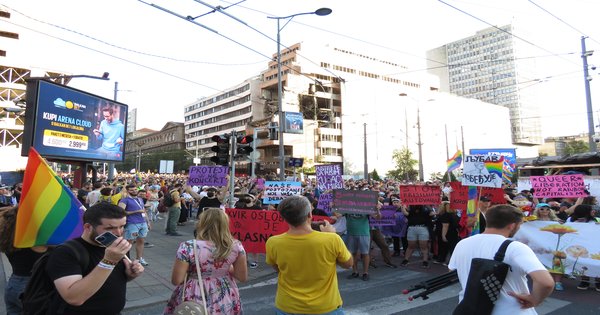
But the trajectory has shifted, unevenly and slowly. The first Sarajevo Pride march happened in 2019 under heavy police protection and real threats of violence. Annual parades have continued since and are no longer classified as high-risk events. The anti-discrimination law, while underenforced, is being used. And now, a hate speech conviction has survived appeal.
None of this means Bosnia is becoming a safe country for LGBTQ+ people. The Sarajevo Open Centre is clear-eyed about that: the community still faces “social hostility and regressive policies.” But a legal framework is forming, piece by piece, through individual cases fought by individual organizations that refuse to stop filing claims.
Why We Cover This
At TrueQueer, we think the Balkans are one of the most important — and most underreported — frontlines for LGBTQ+ rights globally. The region sits at the intersection of EU accession pressures, nationalist politics, and communities that are organizing despite real danger.
Bosnia’s appeal ruling won’t make international headlines. It’s not a marriage equality win or a Pride parade with a million attendees. But it’s the kind of grinding, case-by-case legal work that builds the foundation everything else depends on. Someone had to file the first claim. A court had to issue the first ruling. And now an appellate court has confirmed that the first ruling was right.
That’s how things change.