What the EU's Conversion Therapy Vote Means for the Western Balkans
If Brussels turns this week's parliamentary vote into a binding directive, six candidate countries will have to follow. Five of them have no ban on conversion practices at all.

The European Parliament’s April 29 vote endorsing an EU-wide ban on conversion practices did not name the Western Balkans. It didn’t have to. The six countries currently negotiating accession — Albania, Serbia, North Macedonia, Montenegro, Bosnia and Herzegovina, and Kosovo — are obliged, as part of the deal they want, to align with the EU’s evolving body of law over time. If the Commission turns next month’s response into a binding directive, conversion therapy will be one more line item on the long technical checklist that has to clear before any of them join.
Today, that checklist is uneven. Here is where the candidates actually stand.
Albania: a partial professional ban since 2020
Albania has the strongest position in the region — and that’s a low bar. In May 2020, the country’s Order of Psychologists, the licensing body for psychologists, barred its members from offering conversion practices. The decision made Albania the third country in Europe at the time to take that step. It has real teeth in clinical settings: a licensed psychologist who advertises or performs conversion therapy can lose their license.
What it does not do is reach religious counseling, unlicensed practitioners, or the broader category of informal pressure that LGBTQ+ Albanians describe as the more common experience. There is also no statutory criminal penalty. A binding EU directive would push Albania toward codifying the existing professional rule into national law, with definitions, enforcement, and victim support attached.
Serbia: no ban, deteriorating climate
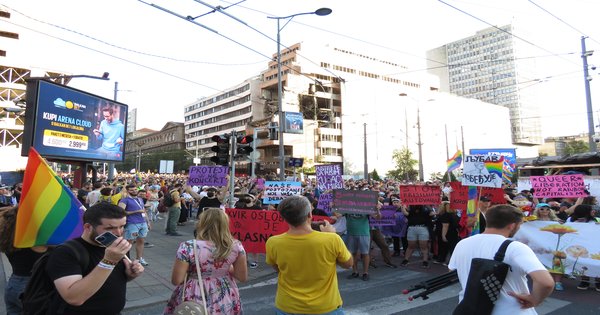
Serbia has no law restricting conversion therapy. The country’s last LGBTI Strategy expired in 2024 and has not been replaced. The 2024 Belgrade Pride march took place under heavy security, with several thousand participants and only minor incidents — but the political environment around LGBTQ+ rights has hardened since the 2022 EuroPride, when then-President Vučić publicly opposed the event before it happened anyway.
Belgrade Pride 2026 is scheduled for the week of August 31 through September 6, with the march set for September 5. Organizers have already opened the call for proposals and are working under a “Pride is People” framing that emphasizes everyday rights rather than legal grand gestures. A directive from Brussels would land into a country whose government is, on most LGBTQ+ questions, going the wrong direction.
North Macedonia: stalled fundamentals
North Macedonia’s Skopje Pride is now in its eighth year and headed toward late June. The country opened formal accession negotiations in 2022, after Bulgaria lifted its veto, and is now working through the fundamental rights cluster. A 2019 anti-discrimination law that explicitly named sexual orientation and gender identity was annulled by the constitutional court on procedural grounds in 2020. The successor law eventually passed but is widely seen as weaker.
There is no conversion therapy ban — statutory, professional, or otherwise. The current center-right coalition government, elected in 2024, has continued to support EU integration while distancing itself from EU cultural policy. A directive would give the local LGBTQ+ movement a new lever, but the political ceiling is real.
Montenegro: civil partnerships, but the easy fights are over
Montenegro became the first non-EU Balkan country to legalize same-sex civil partnerships in 2020, by a single-vote margin in parliament. Implementation has been uneven. There is no conversion therapy ban, no clear path to one, and a coalition government that includes parties hostile to LGBTQ+ rights expansion. The country’s accession talks are advancing — Montenegro is generally regarded as the leader in the candidate group — but its legislature has shown little appetite for new LGBTQ+ legislation since the 2020 partnership vote.
Bosnia and Herzegovina: structurally stuck
Bosnia is the candidate country where everything is harder. The state-level government cannot legislate on social policy without consensus across two entities and three constituent peoples, and conversion therapy has never reached the agenda. The country’s first Pride march, in 2019, took place under enormous security; subsequent ones have continued without serious legal progress.
Bosnia did, however, log a notable win in February 2026, when the Constitutional Court upheld a hate-speech conviction tied to anti-LGBTQ+ statements. It was a narrow ruling on a narrow case, but it was the first time the country’s top court applied the existing law to LGBTQ+ protection at this level. A conversion-therapy directive would land into a system that cannot easily transpose it — but the EU has a long history of using accession leverage to force exactly these kinds of structural moves.
Kosovo: behind, but with momentum
Kosovo is the most behind on the formal framework — its accession application is more recent and its legal architecture is younger — but it has, in some ways, the most receptive political class in the region. Pristina Pride has run continuously since 2017 with municipal support. The country has anti-discrimination protections on the books and a draft civil code that has been promising same-sex partnership recognition since 2018, repeatedly delayed by parliamentary politics.
A binding EU directive on conversion practices would give Kosovo an external deadline to point to, which is often how legislation actually moves in Pristina.
What changes next
The vote on April 29 is, for now, a political signal. The European Commission’s formal response is due May 18, the day after IDAHOBIT — a date the activist coalition pushing the citizens’ initiative chose deliberately.
If the Commission proposes a directive, the negotiation that follows will run for at least 12–18 months. Member states will fight over scope: minors only, or all adults; medical practice only, or religious counseling too; sexual orientation only, or gender identity as well. Whatever lands at the end of that process becomes the floor that the Western Balkans candidates eventually have to meet.
For LGBTQ+ activists in Tirana, Belgrade, Skopje, Podgorica, Sarajevo, and Pristina, the practical question is whether their own governments will move on conversion therapy independently — before Brussels forces the conversation — or wait, as has so often happened, until accession leverage makes inaction more expensive than action.
The April 29 vote did not change the law in any of these countries. It made the question of when it will harder to keep avoiding.