The State of LGBTQ+ Rights in Croatia in 2026: Adoption Won, Marriage Stalled, and a Pride Movement That Carried the Country
Croatia is now the most legally protective country in the Western Balkans for LGBTQ+ people — but the road from constitutional ban to court-ordered adoption rights ran through 25 years of Pride marches, not parliamentary good will.

Croatia sits in an unusual spot on the European LGBTQ+ map. It is constitutionally barred from recognising same-sex marriage thanks to a 2013 referendum that defined marriage as the union of a man and a woman. It is also, in 2026, the country in the Western Balkans where same-sex couples have the most concrete legal protections — registered life partnerships, joint adoption rights, foster-care eligibility, anti-discrimination law that names sexual orientation and gender identity, and a Pride march in Zagreb that has been running, without a ban, for 25 years.
Both things are true. Both things are why understanding Croatia matters if you are trying to read where the rest of the region is going.
Where the law stands today
The single most important piece of Croatian LGBTQ+ legislation is the Life Partnership Act, passed in 2014 in direct response to the constitutional marriage ban. The law gives same-sex couples a registered partnership status that confers nearly all of the rights of marriage in Croatian law — inheritance, healthcare decision-making, social security, residency rights for foreign partners, and stepchild adoption. It does not let couples call themselves married, and it does not give automatic parental rights from birth, but it covers the practical ground in a way that few “civil union” frameworks elsewhere in the region come close to.
The bigger jump came in 2022, when Croatian courts ruled that same-sex couples could pursue joint adoption on the same terms as different-sex couples, closing the last major rights gap left open by the Life Partnership Act. That decision built on an earlier 2020 ruling that opened up foster care to same-sex couples. Both came from the courts, not the legislature, and both were the product of years of litigation pushed by Croatian LGBTQ+ organisations.
Anti-discrimination law in Croatia covers sexual orientation, gender identity, and gender expression in employment, education, health care, housing, and access to goods and services. Hate-crime legislation includes the same protected categories. Trans people in Croatia can update their legal gender, although the procedure still requires medical assessment rather than self-determination, and Croatian advocates have been pushing for a self-ID model in line with what Belgium, Spain, and other EU countries have adopted.
In ILGA-Europe’s most recent Rainbow Map ranking, Croatia placed 17th out of 49 countries — a strong showing relative to its Eastern and Southeastern European neighbours, and a meaningful gap to Albania, Serbia, North Macedonia, Bosnia, Kosovo, and Montenegro, none of which currently offer registered partnerships or joint adoption.
What still does not work
The constitutional bar on marriage equality is not going anywhere absent another referendum, and there is no political coalition in Croatia currently willing to put one on the ballot. That is not just a symbolic problem. The Life Partnership Act is good law on paper but suffers from inconsistent application — particularly around birth certificates of children born to same-sex couples, where some registry offices have refused to list both parents and forced families into court to get their kids’ documents fixed.
Trans healthcare access in Croatia is uneven, with most gender-affirming care concentrated in Zagreb and waiting times that have stretched for younger patients. Self-determined legal gender recognition has not arrived. Hate-crime data collection has improved, but Croatian LGBTQ+ groups continue to flag a gap between reported anti-LGBTQ+ incidents and prosecutions that explicitly invoke the aggravating factor.
The cultural backdrop is also not neutral. The Catholic Church remains a dominant social institution, and conservative political movements with church ties played a central role in the 2013 marriage ban. Anti-LGBTQ+ rhetoric still finds airtime in Croatian media, and rural and small-town queer Croatians still report experiences a long way from the relative comfort of Zagreb’s central neighbourhoods.
Zagreb Pride and the role of the streets
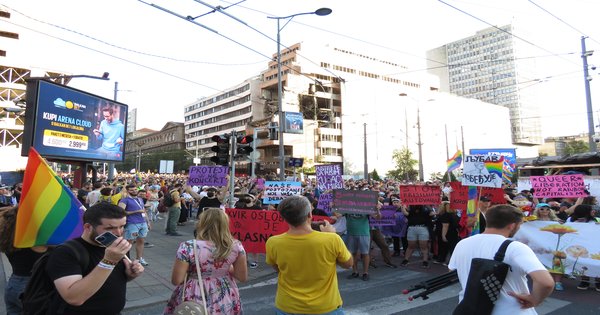
Most of what works in Croatia today was won by community organising, and Zagreb Pride is the most visible piece of that. It started in 2002 with a few hundred people marching under heavy police protection, faced violent counter-protests in its early years, and has since become Southeast Europe’s longest-running annual Pride march. In 2026, Zagreb Pride is celebrating its 25th anniversary, with a route through central Zagreb and an institutional support structure that includes the city government, EU diplomatic missions, and major Croatian civic organisations.
Pride, in other words, is not decorative in Croatia. It is the thing that built the political conditions for the Life Partnership Act, the adoption ruling, and the current Rainbow Map placement. Other Balkan countries are watching that arc closely — Belgrade Pride and Skopje Pride organisers in particular have referenced the Croatian model as a long-game template for how to convert visible street presence into legal protections.
Why Croatia matters to the rest of the region
If you are trying to figure out what the next decade of LGBTQ+ rights looks like in the Balkans, Croatia is the closest thing the region has to a working case study. It joined the EU in 2013 and the Schengen Area in 2023, and a meaningful chunk of its rights progress was tied to alignment with EU non-discrimination directives. Albania, Montenegro, North Macedonia, Serbia, Kosovo, and Bosnia and Herzegovina are all at varying points along that same accession path, and the Croatian arc is one possible map: court rulings doing some of the work the legislature would not, civil society holding the line during the political dips, and a Pride march acting as a yearly visible test of how much progress has actually been institutionalised.
The hard part of that map is that it took 25 years and counting. Croatia is a reminder that LGBTQ+ rights gains in this part of Europe are slow, fragile, and won mostly through the unglamorous work of organising. The good news is that they hold — and once enough of them are in place, the country starts to look meaningfully different from where it began.