EU's Top Court Strikes Down Hungary's Anti-LGBTQ Law in Historic Ruling
The Court of Justice of the European Union found that Hungary's 2021 'propaganda' law violates core EU values — the first time the bloc has ruled a member state breached Article 2 of its founding treaty.

The Court of Justice of the European Union on Tuesday struck down Hungary’s 2021 anti-LGBTQ+ “child protection” law, finding that it violates core EU values and ordering Budapest to repeal it. It is the first time in the bloc’s history that a member state has been found to breach Article 2 of the EU treaties — the article that defines the Union’s foundational values.
The ruling landed nine days after Viktor Orbán’s Fidesz party lost a parliamentary election to the opposition Tisza Party, which had campaigned in part on rolling back the very law the court just invalidated.
What the law did
Hungary’s 2021 law, passed at the height of Orbán’s culture-war turn, banned schools, broadcasters, and advertisers from depicting LGBTQ+ people or topics to anyone under 18. It lumped references to same-sex relationships and gender transition together with pedophilia, forced media content about queer people behind the same age gates used for pornography, and barred it from school curricula entirely.
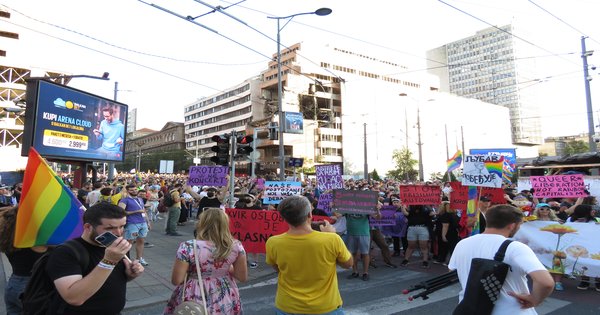
In practice, the law reached far beyond the classroom. Booksellers were fined for displaying queer-themed literature too close to children’s sections. Broadcasters pulled episodes of cartoons featuring same-sex parents. It also became the legal basis Hungarian police cited in 2024 and 2025 when they banned Budapest Pride — a ban organisers defied, drawing more than 100,000 marchers last year.
The largest human rights case in EU history
The European Commission brought the case in 2022, joined eventually by 16 of the 27 member states and the European Parliament itself. It was billed as the largest human rights case in the EU’s history — not only for its scope, but because the Commission asked the court to do something it had never done before: declare that a member state had violated Article 2 of the Treaty on European Union.
Article 2 enumerates the values on which the Union is founded: respect for human dignity, freedom, democracy, equality, the rule of law, and respect for human rights, including the rights of persons belonging to minorities. It is the legal backbone the EU has been reluctant to invoke directly in its long-running disputes with Hungary and Poland.
Tuesday’s judgment broke that reluctance. The court found that by restricting LGBTQ+ content under the guise of protecting children, Hungary discriminated on the basis of sexual orientation and gender identity, violated freedom of expression, interfered with the free movement of services and goods across the internal market, and — crucially — breached the EU’s foundational values.
What happens now
The court ordered Hungary to bring its legislation into compliance with EU law. That means repealing or substantially rewriting the 2021 statute. If Budapest refuses, the Commission can move to daily financial penalties, which in comparable cases have run into millions of euros.
The political context makes compliance more likely than it would have been a month ago. Tisza, the party that defeated Orbán on 12 April, explicitly campaigned on rebuilding Hungary’s relationship with Brussels and rolling back the “propaganda” framework. Incoming prime minister Péter Magyar signalled before the election that the law would not survive his first hundred days. He now has both a mandate and a court ruling pointing in the same direction.
Why this ruling matters beyond Hungary
The decision is a template. Slovakia passed a near-identical “propaganda” law last autumn. Bulgaria’s parliament adopted one in 2024. Romania and Croatia have had similar measures introduced, though not enacted. Each of those laws now stands on legal ground the CJEU has just explicitly declared incompatible with EU membership.
It also changes the calculus for candidate countries. Serbia, Albania, Montenegro, North Macedonia, Kosovo and Bosnia and Herzegovina are all in various stages of EU accession, and several of them have flirted with importing the Orbán model. Tuesday’s ruling makes clear that adopting such a law is no longer a safe signal to conservative voters — it is a direct obstacle to accession itself.
For LGBTQ+ Hungarians, the ruling is vindication after four years in which their visibility was legally treated as a harm to children. For LGBTQ+ people across the Union, it is the clearest statement yet that the EU’s equality commitments have teeth when the political will exists to use them.
The Hungary law is gone, or will be. The question the ruling raises for the rest of Europe is whether Brussels will move with the same confidence the next time a government tries the same playbook.