How the EU Accession Process Is Quietly Reshaping LGBTQ+ Rights in the Western Balkans
Albania and Serbia are racing toward EU membership. The price of admission includes reforms on anti-discrimination, hate crimes, and LGBTQ+ protections — and the effects are already visible.
We’ve been living in Albania, on and off, for over four years now. And if there’s one thing that shapes the political landscape here more than any other single issue, it’s EU accession. It comes up in conversations with taxi drivers, café owners, activists, and government officials. Everyone has an opinion. Everyone wants in.
What’s less discussed — at least in Western media — is how the accession process is forcing tangible changes on LGBTQ+ rights across the Western Balkans. Not out of the goodness of anyone’s heart, but because the EU’s accession criteria include fundamental rights protections, and the European Commission takes notes.
The Mechanism
EU enlargement isn’t a single event. It’s a multi-year negotiation across dozens of policy “chapters,” and Chapter 23 — Judiciary and Fundamental Rights — is where LGBTQ+ protections live. Candidate countries must demonstrate progress on anti-discrimination, hate crime legislation, and the protection of vulnerable groups before they can close this chapter and move toward membership.
For countries like Albania and Serbia, which have been in various stages of the accession process for over a decade, this creates a very specific dynamic: the EU sets benchmarks, the Commission evaluates progress, and governments make reforms — sometimes enthusiastically, sometimes grudgingly, but they make them.
The European Commission’s November 2025 enlargement package was clear: Albania is expected to conclude accession negotiations by the end of 2027, and Montenegro may finish as early as 2026. Serbia’s timeline is murkier, but the roadmap exists and includes specific commitments on LGBTQ+ rights.
Albania: Laws on Paper, Change in Practice
Albania’s legal framework on LGBTQ+ protections is, on paper, surprisingly strong for the region. The country passed a comprehensive anti-discrimination law in 2010 that explicitly bans discrimination on the basis of sexual orientation and gender identity — one of the few countries in the world to include both categories at that time.
But anyone who lives here knows that law and lived reality are different things. Same-sex partnerships aren’t recognized. There’s no legal gender recognition framework for transgender Albanians. And public attitudes, while shifting among younger urban populations, remain conservative — particularly in northern regions and rural areas.
What EU accession pressure does is create accountability. When the Commission publishes its annual progress report, gaps between law and implementation get flagged. Albanian officials who want to keep the accession timeline on track have to respond — not necessarily with sweeping legislation, but with incremental steps: training police on hate crimes, funding LGBTQ+ organizations, ensuring anti-discrimination complaints are actually investigated.
We’ve seen this firsthand. The symbolic same-sex wedding ceremony on Tirana’s municipal rooftop in May 2024 — featuring Alba Ahmetaj and Edlira Maraj — wouldn’t have been possible without the political cover that EU alignment provides. It wasn’t a legal marriage, but the fact that the Municipality of Tirana hosted it sent a signal about where the country wants to be heading.
Serbia: Drafted Reforms, Uncertain Will
Serbia’s situation is more complicated. The country’s EU integration roadmap calls for adopting a law on anti-LGBTQ+ hate crimes and hate speech in 2026, and the government has begun consultations on an updated anti-discrimination framework.
But Serbia’s accession process has stalled repeatedly over other issues — primarily its relationship with Kosovo and the rule of law — and LGBTQ+ rights reforms risk becoming collateral damage when broader negotiations lose momentum. When the EU’s leverage weakens on the big geopolitical questions, the pressure on social issues fades too.
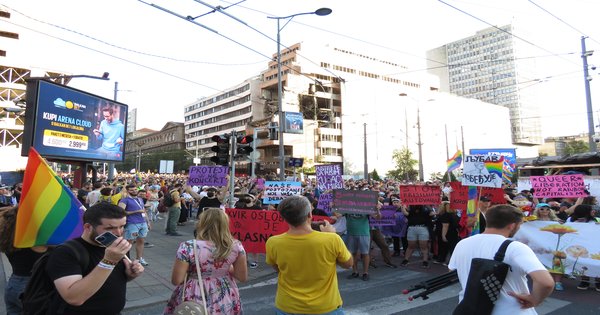
Belgrade Pride has grown into a significant annual event, drawing thousands of marchers under police protection. But the Serbian Orthodox Church remains a powerful conservative voice, and the current government under President Vučić has shown more interest in performative gestures toward the EU than in deep institutional reform.
The civil partnership bill that’s been discussed in Serbia for years has not materialized. Unlike Croatia, which passed life partnerships in 2014, or even Montenegro, which has moved on reproductive rights for LBTQ+ women, Serbia remains stuck in a holding pattern.
The Pattern Across the Region
What makes the Balkans LGBTQ+ story interesting is that the mechanism of change isn’t primarily internal. It’s external. The EU accession process creates a framework where governments adopt reforms they might not otherwise prioritize — not because they’ve had a change of heart, but because the political and economic incentives of membership outweigh the domestic cost of progressive legislation.
This produces a specific kind of progress: legal frameworks advance ahead of public opinion. Laws pass before attitudes fully shift. Protections exist on paper before they’re consistently enforced.
Is that enough? Not on its own. But it’s not nothing. Living in Tirana, we’ve watched the landscape change — not dramatically, not overnight, but measurably. More visible queer spaces. More media coverage that isn’t hostile. A generation of young Albanians who see EU membership and LGBTQ+ acceptance as part of the same modernization package.
The accession process won’t solve everything. Hungary and Poland both proved that EU membership doesn’t prevent democratic backsliding or anti-LGBTQ+ sentiment. But for countries that haven’t yet joined — countries still in the negotiation phase where the EU has the most leverage — the process matters. It creates space for activists to push, for courts to rule, and for governments to act, even when the domestic politics make it difficult.
Albania could be an EU member by 2030. Serbia, maybe later. The LGBTQ+ landscape they bring with them into the union will have been shaped, in significant part, by the conditions the EU imposed on the way in. Whether the reforms stick after accession is the next question — but for now, the process itself is doing real work.