Hungary Charged Its Own Capital's Mayor for Organizing Pride. Now It's Deploying Facial Recognition.
Budapest Mayor Gergely Karácsony faces criminal charges for co-organizing last summer's banned Pride march. Meanwhile, Hungary is gearing up to use biometric surveillance against future attendees — a move the EU says may violate its own AI Act.

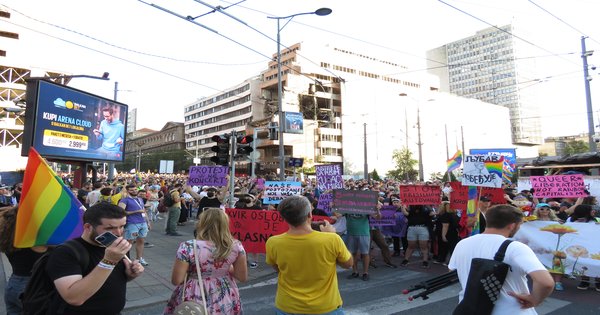
On January 28, Hungarian prosecutors filed criminal charges against Budapest Mayor Gergely Karácsony for his role in organizing last summer’s Pride march — an event the Orbán government had explicitly banned, and which drew an estimated 300,000 people to the streets of the capital anyway.
The charge: organizing an unlawful assembly. Prosecutors say Karácsony “repeatedly published public calls to participate in the assembly, and then led the assembly” in defiance of a police prohibition order. They’ve recommended he face a fine without trial.
It was the largest Pride march in Hungarian history.
How Hungary Got Here
The timeline of Hungary’s assault on LGBTQ+ rights has been swift and systematic. In 2021, the Fidesz government passed a law banning the “portrayal or promotion” of homosexuality or gender reassignment to minors, effectively banning LGBTQ+ content from schools and media. In March 2025, parliament went further, amending the constitution itself to ban Pride events and LGBTQ+ public assemblies outright, passing the measure 136–27.
The stated justification was, as always, “child protection.” The practical effect was to criminalize the most visible form of LGBTQ+ community gathering in the country.
Budapest City Hall, led by Karácsony — one of Orbán’s most prominent political opponents — attempted to sidestep the ban by co-organizing the June 28, 2025 march as a municipal event. Police still issued prohibition orders. The march went ahead anyway.
Now Karácsony is being prosecuted for it. Pride organizers, undeterred, have already announced the next march for June 27, 2026.
Facial Recognition Enters the Picture
But the charges against Karácsony aren’t even the most alarming development. In the same March 2025 legislative blitz that banned Pride, the Hungarian parliament — rushing three amendments through in a single 24-hour session with no public debate — authorized police to deploy facial recognition technology to identify attendees at banned LGBTQ+ events.
Under the law, which took effect April 15, 2025, attending a prohibited Pride event carries fines of up to 200,000 Hungarian forints (roughly $546), with the money directed to “child protection” funds. The biometric surveillance provisions give law enforcement the tools to identify and fine individuals after the fact, even if they can’t stop the march itself.
This isn’t hypothetical. With Budapest Pride 2026 already being planned for June, the infrastructure for mass identification of Pride attendees is now legally in place.
The EU’s Uncomfortable Position
Here’s where it gets legally interesting — and where the EU’s credibility is on the line.
The European Union’s AI Act, adopted in 2024, explicitly prohibits the use of real-time remote biometric identification systems in publicly accessible spaces for law enforcement purposes, except under narrowly defined circumstances like imminent terrorist threats. Article 5 of the Act is clear: facial recognition cannot be used for general surveillance of peaceful assemblies.
Hungary’s Pride surveillance law appears to directly violate this provision. Civil society organizations across Europe, including the Civil Liberties Union for Europe and AlgorithmWatch, have called on the European Commission to act. The Commission has confirmed it is “assessing the reply provided by the Hungarian authorities” to determine compliance with EU law.
But enforcement of the AI Act’s prohibition provisions doesn’t formally begin until August 2, 2026 — conveniently after Budapest Pride is scheduled for June 27. Whether the Commission will take preemptive action or wait for the enforcement deadline remains an open question.
The European Parliament has already condemned Hungary’s Pride ban. The International Bar Association has published analysis concluding the surveillance measures breach EU law. Amnesty International called the ban “a full-frontal attack on the LGBTI community.”
What’s Actually at Stake
This isn’t just about Hungary. The Orbán government has been a laboratory for democratic backsliding within the EU for years, testing how far a member state can push before facing real consequences. The Pride ban and facial recognition provisions are the latest experiment.
If the EU fails to act decisively — before Budapest Pride 2026, not after — it sends a clear signal to other governments contemplating similar measures. Poland, Slovakia, and several other EU member states have their own histories of anti-LGBTQ+ political maneuvering, and they’re watching.
For LGBTQ+ Hungarians, the stakes are more immediate. The Pride ban doesn’t just criminalize a parade. Combined with facial recognition, it creates a system where simply showing up to support your community can result in identification, documentation, and punishment by the state.
That’s not child protection. That’s surveillance authoritarianism with a focus-grouped label.
Karácsony’s Response
The Budapest mayor has been defiant. Since taking office in 2019, he has positioned himself as the face of liberal opposition to Orbán’s nationalist government, and the Pride charges appear to have only strengthened his resolve. The fact that prosecutors recommended a fine rather than imprisonment suggests even the Hungarian judiciary recognizes the political optics of jailing a sitting mayor for organizing a peaceful march.
But the legal precedent matters regardless of the sentence. If Karácsony is convicted, it establishes that organizing a Pride event in Hungary is a criminal act — and that political leaders who support LGBTQ+ rights can be personally prosecuted for doing so.
Budapest Pride 2026 is ten weeks away. Organizers are planning. The government is preparing its surveillance apparatus. And the EU is still “assessing.”
The question isn’t whether Pride will happen in Budapest this summer. After 300,000 people showed up last year, that seems settled. The question is whether Europe’s institutions will protect the people who show up — or leave them to be cataloged by cameras and charged by prosecutors.