IDAHOBIT 2026, Day Of: The EU's Statement, Copenhagen's Forum, and a Quietly Loaded Theme
May 17 is here. The European Union has issued its annual IDAHOBIT statement, the Council of Europe is convening foreign ministers in Copenhagen, and the global theme — At the Heart of Democracy — is doing more work than usual. A day-of look at what is actually happening.
The International Day Against Homophobia, Biphobia, Lesbophobia, Transphobia, and Intersexphobia — IDAHOBIT — is here. May 17 lands on a Sunday in 2026, and the day arrives with three things that are worth pulling apart at the start: an official European Union statement issued yesterday, a Council of Europe forum opening in Copenhagen on Tuesday, and a theme — “At the Heart of Democracy” — that is doing more political work than the usual IDAHOBIT slogan.
We’ve previewed the day in two earlier pieces this month, but today is a different exercise. Today is for naming what is actually on the table.
The EU statement
On May 16, the European External Action Service published the EU’s formal IDAHOBIT 2026 statement on behalf of all 27 member states. It is — as these statements always are — diplomatic in tone. It is also, read carefully, sharper than last year’s.
The statement reaffirms what the EU calls its “strong commitment to uphold the full and equal enjoyment of all human rights by LGBTI persons.” That is the standard line. What is less standard is the explicit pledge to keep funding LGBTI civil society organisations and human rights defenders through “sustained and predictable funding” — language that reads as a direct response to the funding shocks of the last eighteen months. When USAID withdrew most of its global LGBTI portfolio in 2025 and the Trump administration froze State Department democracy and human rights grants, the gap was estimated at roughly 60 percent of total external funding for LGBTI organisations in Eastern Europe and the Balkans alone. The EU’s commitment to “sustained and predictable” funding is a quiet but specific answer to that.
The statement also flags “shrinking civic space and increasing repression” as the operating environment for LGBTI human rights defenders. That phrasing is doing work. It is the language usually reserved for authoritarian contexts, and it is now being applied to a category of people defending rights in countries that include EU member states — a tacit acknowledgment that the threat is not only “out there.”
Copenhagen, May 19
Two days from now, foreign ministers, civil society leaders, and equality bodies from across Europe gather in Copenhagen for the 13th European IDAHOT+ Forum. The forum is co-hosted by the Government of Denmark, the Nordic Council of Ministers, and the Council of Europe. The 2026 theme — “Pushing for Progress” — is paired with the broader IDAHOBIT framing.
The forum matters because it is one of the few venues where European governments make near-term commitments on LGBTI rights in front of one another. Last year’s Malta forum produced concrete pledges on conversion-therapy bans and on protecting Pride events from police bans — pledges that the Council of Europe has been tracking, sometimes uncomfortably for the governments involved. This year’s agenda includes sessions on the implementation gap (laws on the books versus daily reality), on the rollback of trans rights in several member states, and on the funding crisis triggered by US withdrawal.
The Committee of Experts on Sexual Orientation, Gender Identity and Expression and Sex Characteristics will meet alongside the forum on May 20 and 21. That body is the Council of Europe’s vehicle for drafting binding standards — work that has accelerated since the CJEU’s Hungary ruling earlier this year.
”At the heart of democracy”
The 2026 IDAHOBIT theme was chosen through consultation with ILGA World’s regional networks and is — read as a sentence — a deliberate political claim. The claim is that LGBTQ+ rights are not a “cultural” or “lifestyle” file that strong democracies can afford. They are, the theme argues, a load-bearing wall: when they go, the rest of the democratic structure is being prepared for something heavier.
The evidence behind that claim has gotten harder to dismiss. The CJEU struck down Hungary’s anti-LGBTQ+ “child protection” law earlier this year, after years of warnings that the law was a wedge for broader restrictions on speech and assembly. ILGA-Europe’s 2026 Rainbow Map showed eight countries moving backward on LGBTI rights — the same eight, broadly, that have been moving backward on press freedom, judicial independence, and academic freedom. The Rainbow Map and the Reporters Without Borders index now correlate more tightly than at any point since either was first published.
The theme is also a hedge against what organisers expect to be a difficult IDAHOBIT in several countries. Hungary’s outgoing government still controls implementation of the anti-LGBTQ+ law for another six weeks until the new coalition takes over. In Russia and Belarus, public IDAHOBIT events are functionally banned. In Georgia, where the ruling party passed an anti-”propaganda” law modeled on Russia’s, this year’s marker will be private. In Uganda, where the Anti-Homosexuality Act remains in force, IDAHOBIT is being marked through closed gatherings.
What’s actually happening today
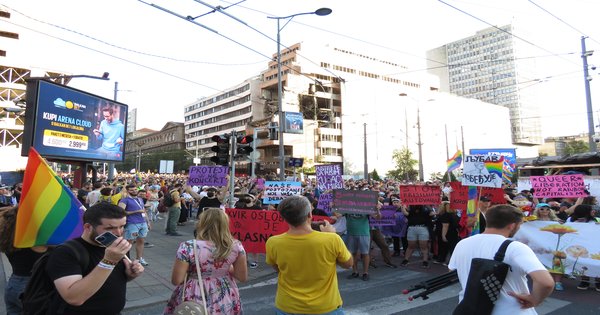
Worldwide, ILGA tracks IDAHOBIT events across more than 60 countries. The picture this year:
In Europe, the most visible public action centers on Amsterdam (where preparations for August’s WorldPride include an IDAHOBIT march), Madrid (where Spain — newly atop the Rainbow Map — is using the day to announce next steps on the equality strategy), and Vienna (Eurovision week, with a fraught flag-policy backdrop covered in our preview last week). Paris, Berlin, Rome, and Brussels all have rallies. In the Balkans, Tirana’s pride season is now six days from its main parade, and IDAHOBIT will be marked with a smaller public gathering near Skanderbeg Square. Belgrade’s IDAHOBIT moment is being staged jointly by civil society and the EU delegation. Skopje and Sarajevo have closed events.
In the Americas, Mexico City and Buenos Aires are running large public programs; in the US, where the federal government is no longer participating in IDAHOBIT in any official capacity, the day is being marked by city governments and by GLAAD’s annual report rollout. Toronto, São Paulo, and Bogotá all have public actions scheduled.
In Asia and Africa, the picture is more mixed and more local. Taipei and Bangkok have public events. Mumbai has a small march. In East Africa, Pretoria and Cape Town have the largest visible programs; Kampala, Nairobi, and Lagos are marking the day through private gatherings and online campaigns.
In Australia and New Zealand, IDAHOBIT is a substantial workplace and school observance — and one that is doing the unglamorous work the day was designed for: getting kids and colleagues to talk about why the day exists in the first place.
What to watch this week
Three things, beyond the day itself.
One: the Copenhagen forum’s communiqué. If the foreign ministers in attendance commit to a specific timeline for the EU LGBTIQ Equality Strategy 2026–2030 implementation review, that is news. If they don’t, that is also news.
Two: how many EU member-state heads of government issue their own IDAHOBIT statements today, and whether the language matches or undercuts the EU’s. Spain, Germany, the Netherlands, Ireland, and Portugal are reliable. The interesting question is what comes out of Italy, Hungary (under its outgoing government), Slovakia, and the new Polish government.
Three: the Tirana Pride march on May 23 — six days from now — which has now become a useful barometer for Western Balkans LGBTI politics. A large, peaceful turnout with visible municipal participation strengthens the EU accession argument. A police-managed counter-protest weakens it. We’ll cover the day live.
For today, the message of the slogan is the message of the day. Equity for LGBTQ+ people and the health of democracies are now, in 2026, the same conversation.