IDAHOBIT 2026 Lands May 17 With Theme 'At the Heart of Democracy'
The International Day Against Homophobia, Biphobia, and Transphobia returns May 17 with a theme that links queer rights to democratic backsliding. Sixteen days out, here's what the day is, what's planned, and where the global picture sits.

The International Day Against Homophobia, Biphobia, and Transphobia — IDAHOBIT — falls on May 17 each year, marking the day in 1990 that the World Health Organization removed homosexuality from its International Classification of Diseases. The 2026 edition lands on a Sunday and arrives with a theme chosen through extensive consultation across regional and global LGBTQ+ networks: “At the heart of democracy.”
The framing is deliberate. Organizers — including ILGA World, the international federation that coordinates the day — have spent the last two years watching the same pattern repeat in country after country: the rights of LGBTQ+ people are framed as a “wedge” in the democratic erosion playbook, then used to test how far a government can go before institutions push back. The 2026 theme is a counter-claim that the question is upside down. Queer rights, the day’s organizers argue, are not a luxury that strong democracies can afford — they are part of how you tell whether a democracy is still working.
What the day is, briefly
IDAHOBIT (sometimes shortened to IDAHOT or IDAHO depending on which letters a country has chosen to add over the years) is observed in more than 130 countries. It is decentralized. There is no single global organizer; ILGA World provides the unifying theme each year, and individual organizations, governments, embassies, and informal community groups choose how to mark it locally. That structure is part of the design — it lets the day mean different things in Madrid, Manila, Maputo, and Mexico City without requiring agreement on a unified message.
The May 17 date is fixed and non-negotiable. It is the only fully secular global LGBTQ+ rights observance with that kind of date discipline. Pride marches move around the calendar by city; IDAHOBIT does not.
Why “the heart of democracy” this year
The theme tracks a specific political reality. Anti-LGBTQ+ legislation has been one of the clearest leading indicators of democratic backsliding for the last decade. Hungary’s 2021 propaganda law preceded its broader rule-of-law confrontation with the EU. Russia’s “gay propaganda” law foreshadowed the country’s full pivot to authoritarianism. In the United States, the wave of anti-trans state legislation since 2020 has run alongside attempts to limit voting access, restrict protest, and reshape judicial review. None of these patterns are coincidences.
The “heart of democracy” framing inverts the usual political talking point that LGBTQ+ rights are a “values” question separate from the “real” democratic agenda. ILGA World’s argument is that you cannot have functioning judicial review, free expression, or genuine protection of minority rights while carving out a category of citizens whose protections you are willing to bargain away.
What’s planned around the world
National and city-level programming is still firming up, but the broad shape of the 2026 day is in place.
In Western Europe, embassies and ministries are coordinating the usual mix of flag raisings, panels, and statements, with several countries — Spain, France, Portugal — planning announcements timed to the day. The Spanish government is expected to use IDAHOBIT week to highlight its in-progress trans healthcare decree, which is meant to harmonize gender-affirming care across all 17 autonomous communities.
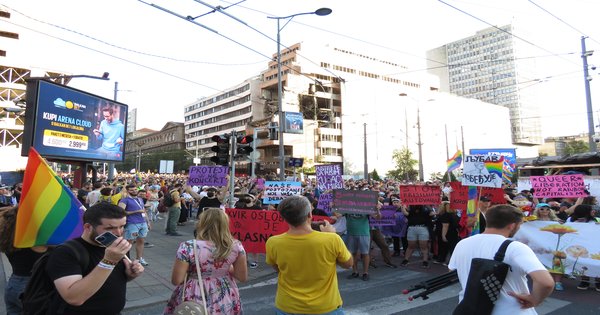
In the Balkans, IDAHOBIT this year falls in the run-up to the regional Pride season. Albania’s Tirana Pride is scheduled for May 23, six days after IDAHOBIT, which means the two events bookend a single week of LGBTQ+ programming in the country. Similar overlap exists in North Macedonia, where Skopje Pride heads toward late June. Local organizations in Serbia, Bosnia and Herzegovina, and Kosovo are coordinating events under the same theme.
In the United States, observances will be smaller and largely community-led. Federal participation in IDAHOBIT, which had ramped up under the Biden administration, has been rolled back. State and city governments in jurisdictions with strong LGBTQ+ protections — California, New York, Washington, Massachusetts, Illinois — are running their own programming. The Human Rights Campaign and GLAAD are coordinating digital campaigns.
Across Latin America, ILGALAC has organized a regional convening linked to the day. Mexico City’s government will host the largest in-person event in the region, drawing on the city’s ongoing reputation as a LGBTQ+ rights leader on the continent.
In Asia, Thailand’s Pride Month begins June 1 but anchors several IDAHOBIT events as well, and the marriage equality law that took effect in early 2025 has now produced more than 26,000 registered same-sex marriages. India’s queer organizing remains divided across regional networks, with significant programming planned in Mumbai, Bengaluru, and Delhi.
Across Africa, the picture is the most fragmented and most dangerous. In Kenya, South Africa, and Botswana, IDAHOBIT will be observed publicly. In countries with criminalization laws — Uganda, Ghana, Senegal, Nigeria — most observance will be private or coded. Senegal’s first conviction under its toughened anti-gay law, handed down in March, will sit in the background of any 2026 commemoration there.
The numbers behind the day
Same-sex acts are still criminalized in approximately 64 countries, and a handful retain the death penalty. Trans people face restrictions — bans on legal gender recognition, bans on gender-affirming healthcare, exclusion from sports and public facilities — in dozens more. According to ILGA-Europe’s most recent annual review, anti-trans legislation has been the fastest-rising category of new restrictive law in Europe over the last three years, even as marriage and partnership recognition has continued to expand.
What IDAHOBIT 2026 asks each of those countries is the question the theme implies: are these laws compatible with calling yourself a democracy? It is the kind of question whose answer depends on what you think democracy is for.
How to mark the day
Most observers do something small: a flag, a social post, a donation, a conversation. ILGA World maintains a list of national focal points and event calendars at may17.org. The single best practical move for readers in the United States is to check whether your state or local LGBTQ+ legal organization has a campaign or fund associated with the day — the funding picture for legal defense work has gotten significantly tighter in 2026 — and to give if you can.
Sixteen days to go.