Kosovo Promised LGBTQ+ Civil Unions. Two Years Later, It's Still Just a Promise.
Prime Minister Kurti pledged to legalize same-sex civil unions by May 2024. The deadline passed, an election came and went, and Kosovo's LGBTQ+ community is still waiting.

In May 2024, Prime Minister Albin Kurti told international media he would push to legalize same-sex civil unions in Kosovo. It would have made Kosovo the first Muslim-majority country in the world to legally recognize same-sex partnerships — a historic step for a young nation trying to prove its European credentials.
That deadline came and went. Then came an election. Then came silence.
Two years later, same-sex couples in Kosovo have no legal recognition, no inheritance rights, no hospital visitation protections, and no indication that any of this is about to change. The promise has become one of the Balkans’ most conspicuous examples of progressive rhetoric that never translates into policy.
What Kurti promised
Kosovo’s constitution already prohibits discrimination based on sexual orientation — it’s one of the most progressive constitutions in the region on paper. And Kurti’s Vetëvendosje movement has positioned itself as Kosovo’s modernizing, pro-European force, making LGBTQ+ rights a natural fit for its brand.
In 2024, Kurti publicly stated his intent to adopt civil union legislation. The announcement drew international attention, particularly because Kosovo’s population is roughly 96% Muslim. While Kosovo is overwhelmingly secular in practice — it has no state religion and alcohol flows freely in Pristina’s busy café scene — the cultural conservatism around LGBTQ+ issues remains strong, especially outside the capital.
Civil society organizations, including CEL (the Center for Equality and Liberty), worked closely with government officials to draft legislation. The groundwork appeared to be in place.
What went wrong
The short answer: politics. The longer answer: everything else came first.
Kosovo’s political bandwidth in 2024 and 2025 was consumed by the ongoing dispute with Serbia, EU-mediated normalization talks, and internal governance challenges. LGBTQ+ civil unions, while symbolically important, were never going to compete with questions of sovereignty and international recognition for parliamentary time.
Then came the February 2025 elections. According to Human Rights Watch’s World Report 2026, political parties across the spectrum “frequently used discriminatory and denigrating rhetoric about lesbian, gay, bisexual, and transgender people” during the campaign. Even Vetëvendosje, which had made the civil union promise, went quiet on the issue as it fought to maintain its parliamentary position.
The elections produced a fragmented parliament and months of political deadlock. LGBTQ+ legislation fell off the agenda entirely.
The gap between paper and practice
Kosovo has one of the better legal frameworks for LGBTQ+ rights in the Western Balkans — at least on paper. Anti-discrimination protections cover sexual orientation and gender identity. The government adopted an “Action Plan for the Rights of LGBTI Persons 2024–2026,” the first of its kind, covering health, education, anti-discrimination, and awareness-raising.
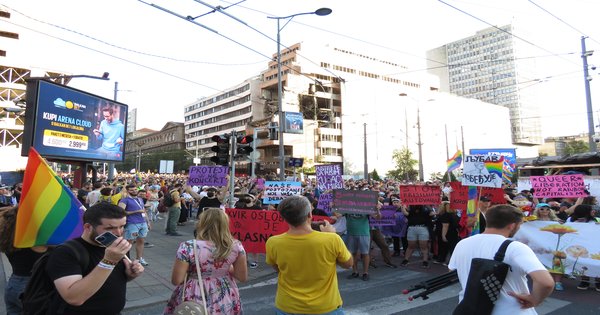
But implementation has been minimal. The CSO Coalition Margini continues to document cases of violence and discrimination against LGBTQ+ individuals. Social acceptance remains low. Pristina Pride, while growing each year, is still a modest affair compared to Zagreb or even Tirana.
The gap between Kosovo’s progressive legal framework and its lived reality is one of the region’s sharpest contradictions. The laws say one thing. The streets say another. And the legislature hasn’t been willing to close the distance.
What this means for the region
Kosovo’s stalled civil unions matter beyond its borders. The Western Balkans are in a slow-motion race toward EU alignment, and LGBTQ+ rights are explicitly part of the accession criteria. Montenegro, Serbia, North Macedonia, and Albania all face similar pressures to demonstrate progress.
If Kosovo — arguably the most pro-Western, pro-EU government in the region — can’t deliver on a civil unions promise, it signals to other Balkan governments that the political cost of LGBTQ+ legislation still outweighs the EU’s leverage. That’s a discouraging message for activists across southeastern Europe who have been counting on the accession process to force change.
Croatia remains the only former Yugoslav state with legal recognition of same-sex partnerships. That was enacted in 2014. More than a decade later, no other Western Balkan country has followed.
Where things stand now
There’s been no renewed push for civil union legislation in the current parliament. The LGBTQ+ action plan runs through 2026, but without the headline legislative achievement it was supposed to accompany, it risks becoming a document that checks boxes without changing lives.
Kosovo’s LGBTQ+ community isn’t waiting for the government. Organizations like CEL and Kosovo 2.0 continue to build visibility and advocate for change. Pristina’s queer social scene, while small, is growing. But none of that replaces what was promised and not delivered.
Kurti’s civil union pledge was important because it said something about what kind of country Kosovo wants to be. Its abandonment says something too.