Montenegro's Civil Partnerships Approach Five Years: A Quiet Balkans Win, an Unfinished Adoption Fight
Montenegro became the first Western Balkans country to recognize same-sex unions when its Life Partnership Law took effect in July 2021. As the five-year mark approaches, the law has held — but adoption rights are still locked out, and the political winds aren't getting easier.
In two months, Montenegro’s Life Partnership Law turns five. It is the first piece of legislation of its kind in the Western Balkans, and the run-up to its anniversary is a useful moment to look at what a small country with a fragile EU accession path has actually managed to deliver for its LGBTQ+ community — and where the law is still walking into a wall.
Parliament passed the Life Partnership Law in July 2020. After a delay around regulation drafting, it took effect July 15, 2021. The law gives same-sex couples a registered partnership status with most of the legal protections of marriage: inheritance, hospital visitation, social security, tax treatment, immigration sponsorship, the right to make medical decisions for an incapacitated partner. It does not give them the right to jointly adopt a child, and it does not call what they have a marriage.
That gap matters, and we’ll come back to it. But for a country of about 600,000 people in a region where every neighbor except (now) Slovenia has rejected similar legislation, getting the law on the books at all was a substantive win.
How the law has actually been used
By the most recent count released through the Ministry of Human and Minority Rights, around 75 same-sex partnerships had been registered in Montenegro by late 2023, with the largest clusters in the coastal town of Budva, the capital Podgorica, the historic seaside town of Herceg Novi, and the Adriatic port city of Bar. Anecdotal reporting from Queer Montenegro and from registry-office staff suggests the pace has stayed roughly steady since, putting the running total at somewhere over 100 by spring 2026 — a small absolute number, in line with what civil partnership uptake has looked like in similarly sized European countries in their first half-decade.
What’s more telling is what hasn’t happened. Civil servants in Podgorica and Budva have, by all available accounts, processed registrations without obstruction. The legislative compromise that put the law on the books — passed in a 42-5 vote with the support of the country’s then-pro-Western governing coalition — has held even as Montenegrin politics has churned through three different governments since. The Democratic Party of Socialists, then the broad For the Future of Montenegro coalition, then Prime Minister Milojko Spajić’s Europe Now Movement: none of them have moved to repeal or weaken the law.
For a Balkans country, that is the win. The law has become part of the legal architecture, not a political football to be re-litigated every cycle.
What it doesn’t do
Adoption is the obvious gap. Couples in registered partnerships cannot jointly adopt, and a partner cannot adopt the biological child of the other partner. For couples who already have children — through previous relationships, or through assisted reproduction abroad — this leaves the non-biological parent without legal recognition and exposed in custody, school, and medical settings.
Activists at Queer Montenegro and LGBTIQ Social Centre have pushed for an adoption amendment since 2022. The political ceiling has been low. Successive governments have signaled they will not reopen the legislation, partly out of fear of provoking a backlash from the Serbian Orthodox Church, partly because the original 2020 vote was understood as a one-shot compromise: marriage in everything but name and adoption.
Trans rights are also lagging. Legal gender recognition in Montenegro still requires a medical assessment, and the country has not joined the cluster of European states moving toward administrative-only models. The Council of Europe and ILGA-Europe have both flagged this as an outstanding obligation.
What EU accession has, and hasn’t, done
Montenegro has been negotiating EU accession since 2012 and is widely considered the front-runner among Western Balkans candidates. The Life Partnership Law was, by most external readings, partly a product of accession-era leverage: an EU-aligned coalition delivering on a chapter of the acquis in a way that is also legible to Brussels.
But the same accession process has not produced movement on adoption or marriage equality. EU law leaves family policy to member states, and the European Court of Justice has so far required only freedom-of-movement recognition, not domestic equivalence. Montenegro can be deemed compliant without doing more.
The recent ECJ ruling against Hungary’s anti-LGBT law, which our regular readers have seen us cover, is a useful contrast. EU institutions can punish anti-LGBTQ+ regression. They have so far shown less appetite for compelling pro-LGBTQ+ progress beyond the floor.
Pride and what comes next
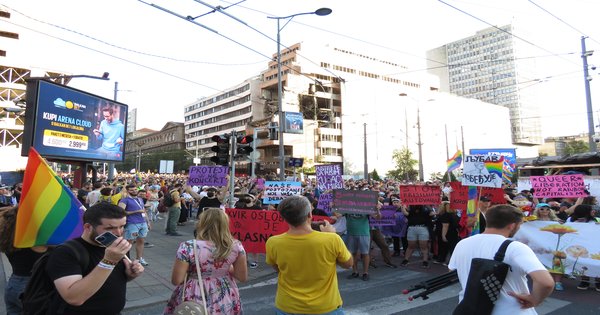
Podgorica Pride, the annual march organized by Queer Montenegro and the Montenegro Pride Organizing Committee, is scheduled for September 2026. Last year’s march drew several hundred participants and was held under heavy police protection without major incident. Pride in Podgorica has, since its 2013 debut, gone from impossible to routinely possible to — increasingly — boring in the best sense of that word: a regular civic event the state simply does its job around.
That, more than the partnership law itself, is what five years of legal recognition look like. The law didn’t change Montenegrin society overnight. It made queer life legible in a context where it had been invisible. The visible work of building a community, holding marches, opening venues, and pushing for the next round of reforms still falls to the Queer Montenegro generation that has been doing it for fifteen years.
Five years in, the law is doing what it was meant to do for the people who use it. The harder questions — adoption, gender recognition, full marriage equality — sit waiting for whatever government Montenegro elects next, and whatever signal Brussels chooses to send about whether equality is a floor or a ceiling.
Sources: LGBTQ rights in Montenegro — Wikipedia; Recognition of same-sex unions in Montenegro — Wikipedia; Montenegro’s LGBTQ+ Community Celebrates Self-Determination — WeBalkans EU; Montenegro country profile — ILGA-Europe / ERA-LGBTI.