North Macedonia's LGBTQ+ Movement Is Being Squeezed From Two Sides — And One of Them Is the United States
USAID's withdrawal pulled an estimated 10–20% of annual funding from North Macedonian civil society. For LGBTQ+ organizations already navigating the Western Balkans' weakest rights environment, the math is brutal.

If you have been wondering what the Trump administration’s USAID dismantling actually looks like on the ground for LGBTQ+ communities, North Macedonia is a case study you should be watching.
According to the Macedonian Center for International Cooperation (MCIC), an estimated $37 million in pledged USAID funding to North Macedonian civil society — roughly 10 to 20 percent of the annual budget of the country’s NGO sector — never arrived after Washington pulled the plug in 2025. That cut hit a civil-society ecosystem that does not have deep domestic philanthropy to fall back on, and it hit hardest the organizations doing the most politically uncomfortable work. LGBTQ+ rights groups, anti-corruption watchdogs, and women’s-rights organizations were disproportionately funded by US aid, and they are the ones now staring at half-staffed offices and gutted program budgets.
Why this matters in the Western Balkans context
North Macedonia is already the lowest-ranked country in the Western Balkans on ILGA-Europe’s Rainbow Map. It has no legal recognition of same-sex partnerships, no streamlined gender-recognition process, and a Constitutional definition of marriage that excludes same-sex couples. A 2023 World Bank report estimated that workplace exclusion of LGBTQ+ people costs the country 0.13% of GDP — small as a fiscal number, but a lot of unemployed and underemployed people behind that decimal.
Layer on the political context. The country has been led, since 2024, by a VMRO-DPMNE-led government that has been openly hostile to civil-society actors it views as foreign-aligned. Human-rights defenders advocating for gender equality and LGBTQ+ rights are routinely labelled “foreign agents” in pro-government media — a familiar playbook from Hungary, Russia, and Georgia. The shrinking of civic space was already happening before the USAID cut. The cut just removed the financial cushion that had allowed organizations to keep operating despite the political pressure.
The funding math, plainly
Here is the rough picture of who funds Western Balkans LGBTQ+ civil society:
- The European Union (via IPA pre-accession funds and country-level programs)
- Individual EU member states (Sweden, Germany, Switzerland, the Netherlands)
- Private philanthropies (Open Society Foundations, smaller queer-specific funders)
- The United States (USAID and State Department democracy-and-human-rights programs)
USAID was not the largest single donor in most countries, but it had two unusual properties: it funded operating costs (not just project costs), and it was willing to fund explicitly political work like documenting hate crimes and lobbying for legal change. EU funding tends to come with project-by-project requirements that make it harder to keep an organization’s lights on when there is no live grant. The result of removing US funding without anyone backfilling it is that organizations are either shrinking, merging, or going dark on advocacy and falling back to service provision they can sustain on smaller, more restrictive grants.
The Swiss Agency for Development and Cooperation has emerged as one of the more reliable remaining donors, particularly on governance and anti-corruption work. But there is no honest way to say that Swiss money or EU money has replaced the scale of what USAID was contributing.
What’s actually being lost
Concretely, what does an LGBTQ+ NGO in Skopje stop doing when its budget gets cut by a fifth or a quarter?
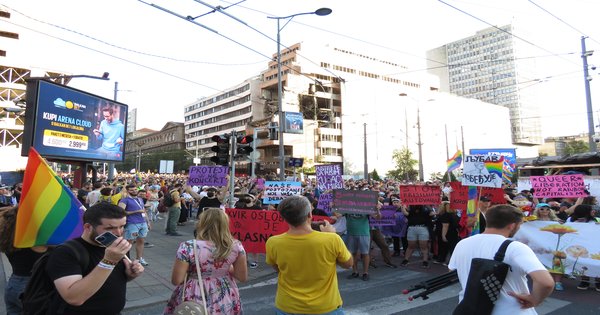
It stops monitoring hate crimes and discrimination cases at scale, because that requires paid staff time and legal expertise. It stops the slower, less-glamorous work of training police, prosecutors, and journalists. It scales back legal aid for trans people seeking gender recognition or LGBTQ+ refugees applying for asylum. It cancels or shrinks Pride-week programming that depends on small grants stitched together each year. It loses institutional memory when senior staff leave for jobs in Western Europe or the EU institutions, because there is no longer the budget to retain them.
None of this shows up as a single dramatic news event. It shows up as a gradual loss of capacity that becomes visible only later, when a discrimination case doesn’t get documented, when a hate-crime statistic stops being reported, or when an annual report that used to be a basic accountability tool just doesn’t get published anymore.
What advocates are asking for
The asks from organizations like Coalition MARGINS, ERA-LGBTI, and ILGA-Europe in recent months have been pragmatic: faster disbursement of EU pre-accession funds with more flexibility to cover operating costs; more European national donors stepping up to fill specific country gaps; and a louder public posture from EU institutions linking civic-space conditions in candidate countries — including treatment of LGBTQ+ organizations — to accession progress. North Macedonia’s EU accession path remains theoretical, but rule-of-law and human-rights conditionality is one of the few non-rhetorical levers Brussels has.
For everyone watching the Balkans from outside the region: this is the moment where individual donations, organizational partnerships, and even just amplification of Western Balkans LGBTQ+ stories actually matter. The infrastructure built up over the last fifteen years — slowly, against real political headwinds — does not rebuild itself easily once it gets dismantled. And nobody is coming to rescue it from across the Atlantic.