100+ Polish NGOs to Tusk Government: Stop Cherry-Picking Which Court Rulings You'll Obey
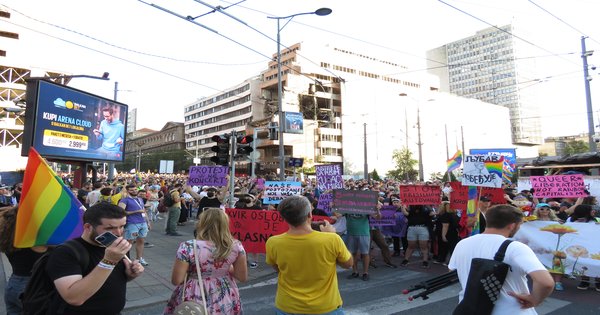
Over 100 rights groups, including Amnesty International and Poland's Supreme Bar Council, signed an open letter demanding the government implement court orders to recognize same-sex marriages performed abroad — after the Interior Minister suggested it wouldn't.
More than 100 Polish civil society organizations signed an open letter on Tuesday demanding that Prime Minister Donald Tusk’s coalition government actually do what two separate courts have now ordered it to do: recognize same-sex marriages that Polish citizens lawfully contract in other EU member states.
The signatories include Amnesty International Poland, the Helsinki Foundation for Human Rights, and — notably — the Supreme Bar Council, the official body representing Poland’s legal profession. Their message is unusually blunt for Polish civil society discourse. “The rule of law does not operate selectively,” the letter reads, according to a translation of the Polish original. “If it stops applying in one case, it stops applying altogether.”
What the courts have already ordered
Two rulings are at stake. In November 2025, the Court of Justice of the European Union held — for the third time in eight years — that EU member states must recognize same-sex marriages validly concluded in another member state for purposes of residency and family rights. Poland, along with Romania, Bulgaria, Slovakia, and Hungary, had spent the better part of a decade ignoring the previous two rulings.
Then, on March 20, 2026, the Supreme Administrative Court of Poland (Naczelny Sąd Administracyjny, or NSA) ordered a Warsaw registry office to transcribe the marriage certificate of two Polish men who had lawfully married in Germany. The ruling specifically cited the CJEU judgment and held that Poland’s constitutional ban on same-sex marriage — which defines marriage as between a man and a woman — does not relieve the state of its obligation to recognize lawfully contracted unions from abroad for administrative purposes.
That should have settled it. Instead, Interior Minister Marcin Kierwiński said the NSA ruling applies only to “one very specific relationship” and that broader recognition would require changes to Polish law — changes that would certainly be vetoed by President Karol Nawrocki, a conservative who took office last August after defeating a liberal candidate from Tusk’s own coalition.
The letter’s core argument
The NGOs are not asking for marriage equality. That fight is blocked for now by the constitution and the presidency. What they are asking for is something narrower and, they argue, legally unambiguous: that the government stop treating court rulings as optional.
“In a democratic state governed by the rule of law, the government has no authority to decide which judgments merit enforcement,” the letter states. The signatories argue that Kierwiński’s “one very specific relationship” framing is incompatible with how Polish administrative law actually works — a ruling from the Supreme Administrative Court is, by design, precedential for analogous cases. Treating it as binding only on the two specific men named in the case, the organizations contend, is not a legal position but a political choice dressed up as one.
The involvement of the Supreme Bar Council matters here. Bar councils across Europe have increasingly become public defenders of rule-of-law norms when governments waver. When the official voice of Poland’s lawyers signs onto a letter accusing the government of selective enforcement, that carries institutional weight that’s hard to dismiss as activism.
Why Tusk is stuck
When Tusk returned to power in late 2023, he made explicit campaign promises to Polish LGBTQ+ voters: civil partnerships, simpler gender recognition, an end to the “LGBTI-free zones” that had metastasized under Law and Justice. Some of those promises have been kept — the LGBTI-free zones were formally repealed and Poland’s climb on the ILGA-Europe Rainbow Map reflected that. Others have died in coalition negotiations. The centrist-Christian Polish People’s Party (PSL) refuses to support civil partnerships, and the coalition settled instead for a watered-down “cohabiting partners” framework that has yet to pass.
The Interior Minister’s reluctance on marriage recognition fits that pattern. Implementing the NSA ruling would be legally correct but politically expensive — it would hand conservative media a “Tusk is sneaking in gay marriage” talking point, and it would almost certainly trigger a presidential veto of any legislative codification. Kierwiński’s strategy appears to be to limit damage by implementing the ruling in the single case that produced it and daring the courts, and now civil society, to force him further.
What happens next
The NGOs did not set a deadline, and they didn’t need to — the next test case is almost certainly already in the pipeline. Polish same-sex couples who married in Germany, the Netherlands, Spain, or any other EU state can now walk into a Polish registry office armed with a Supreme Administrative Court precedent. Each refusal to transcribe a marriage is appealable. Each appeal produces another ruling.
For Polish LGBTQ+ families, this is far from abstract. Recognition of a foreign marriage in Poland unlocks questions of residency for non-Polish spouses, inheritance, pension rights, hospital visitation, and — critically — the legal status of children. The Interior Minister’s position is that these families should wait for legislation that everyone involved knows is not coming soon. The courts, and now more than 100 civil society organizations, have said that’s not how the rule of law works.
Whether Tusk agrees is about to become one of the defining tests of whether his government is actually building something different from what came before, or just governing it more politely.