Three Days From Tirana Pride: The Panel, the Interview, and the Speech We Were Not Expecting
Tirana Pride 2026 is Saturday. We spent Wednesday at the public EU accession panel and in a long sit-down with a PINK Embassy organizer who has been at this since 2012. The most interesting moment came from somebody we did not have on the schedule.
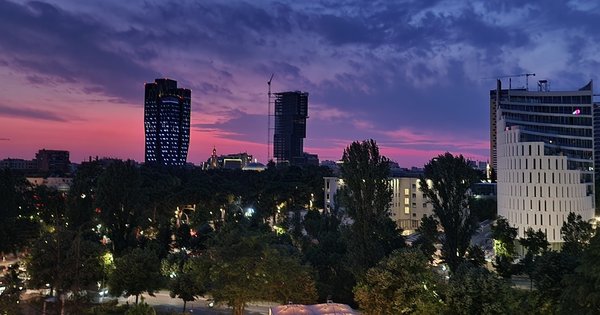
Three days. Tirana Pride 2026 marches Saturday, May 23. We are filing this Wednesday night from the kitchen of the apartment we have been renting on Rruga Ibrahim Rugova, because the café we usually write from closed at nine and the panel we went to ran until almost ten. The neighbors above us are playing something with a heavy bass line and the windows are open. That is all part of the story tonight, actually.
The interview — what twelve years of organizing teaches you
We sat down Wednesday afternoon with one of the PINK Embassy organizers who has been part of every Tirana Pride since the very first one in 2012. We had agreed in advance not to publish her name in the daily dispatches; her work has gotten harder in the last year, not easier, and a quotable name in an American-coded outlet is the kind of thing that can be weaponized in a Tirana newsroom by people who want it weaponized. We will call her A.
What A told us, over an hour and a half and two coffees at the same Tirana International Hotel café where we had sat in on Tuesday’s closed working session, is that the most underrated transformation in Albanian LGBTQ+ organizing over the last decade has not been the legal one. It is the supply chain. In 2012, she told us, when they wanted to print Pride posters, the first three print shops they approached refused. By 2018, every print shop they had ever asked said yes. This year, the print shop they used quoted them a discount of their own initiative and asked if they wanted to print a small run of extra posters that the shop’s owners would put up themselves around their neighborhood, on their own time, with their own ladders.
We asked A what she would have said in 2012 if you had described that conversation to her. She thought about it for a long moment and then said: “I would have told you that you were lying or that you were talking about a different country.”
That is the line we are still thinking about three hours later. It does not appear in any rights index. It will not show up in any EU progress report on Cluster 5. It is the kind of texture you only get from people who have been doing the work long enough to notice the difference between the city in which they started and the city they are standing in now.
The public panel — what the politicians said versus what they did
The Wednesday-evening public panel at the Tirana International Hotel was the one we were ostensibly there for. Three Albanian MPs, two EU delegation staffers, one Council of Europe representative, and a moderator from a local civil society outlet. The room was at capacity — somewhere around 120 people — and at least half of those people were under thirty.
The most interesting thing about the panel was that everybody said roughly what we expected them to say. The PS-aligned MP committed to civil-partnership legislation “within the current parliamentary term,” which in our reading means after the next election. The opposition MP — from a smaller, newer party — said the same thing but with slightly more urgency. The EU staffer said “Cluster 5 progress is conditional on demonstrable progress” in three different sentences. None of this is news. None of this told us anything we did not already know from reading the Council of Europe’s last horizontal-facility report on Albania.
The interesting moment came near the end of the question-and-answer period.
The speech we were not expecting
A young man — early twenties, soft-spoken — stood up during the Q&A and told the panel, without any visible nerves, that he had come out to his family three months ago and that his family had not spoken to him since. He said he was studying in Tirana on a scholarship and that his scholarship money came from his father’s village, and that he did not know what would happen when he had to go home for summer. He asked the panel, very plainly, whether any of the legal protections they had been talking about for an hour would actually do anything for him.
The MPs did the thing that politicians do when they cannot answer a question, which is to answer a slightly different question. The EU staffer was honest enough to say: “Probably not in the way you mean. Not yet.”
What happened next is what we will remember from this Pride. Three people in the audience — strangers, near as we could tell, not connected to one another — stood up one after the other and told the young man, on the microphone, that he could stay with them. Two of them gave the address of their apartment. One offered to pay his rent if it came to that. The moderator, who had been keeping the panel on a tight clock, did not interrupt any of them.
We have been to a lot of LGBTQ+ events in a lot of European countries. We have never seen anything quite like that.
The young man cried a little. So did we, sitting near the back, trying not to write anything down because writing felt like the wrong response to what was happening in the room.
What we are doing tomorrow
Thursday is the film-screening dispatch, which is a smaller, lower-key piece we are putting together with one of the local programmers. The film is Sworn Virgin, the 2015 Albanian-Italian co-production about the kanun tradition of burrnesha — women who took an oath to live as men, with the social rights of men, under traditional Albanian law. It is being screened Thursday night at a small venue in the Pazari i Ri area, with a panel discussion afterward about how that older Albanian tradition of gender nonconformity sits alongside today’s much younger trans-rights movement. We will write that up Thursday night.
Friday is the U.S. Embassy reception. Saturday is the march.
If you are coming and want to meet up: panel rules from yesterday’s dispatch still apply — second-to-third row of the march, behind the organizing coalition’s banner, in front of the trans-rights bloc.
The bass line upstairs has just stopped. We are going to bed.
Three days.