Two Days From Tirana Pride: A 2015 Film About Sworn Virgins and a Room Full of People Arguing About Gender
Tirana Pride 2026 marches Saturday. Thursday night we went to a screening of Sworn Virgin and stayed for a panel that turned into the most honest conversation about gender we have heard in Albania.
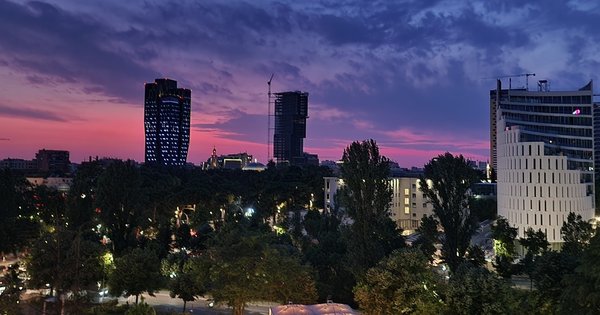
Two days. Tirana Pride 2026 marches Saturday, May 23, and tonight we are writing from a wine bar two streets off Pazari i Ri, because the screening we went to let out late and neither of us wanted to go straight home and lose the conversation we had been having on the walk back.
As we said in Wednesday’s dispatch, Thursday was always going to be the quiet one — the film-screening dispatch, the lower-key piece. It did not turn out quiet at all.
The film
The screening was Sworn Virgin, the 2015 feature directed by Laura Bispuri, adapted from the novel by the Albanian writer Elvira Dones and starring Alba Rohrwacher. It is about the tradition of the burrnesha — the Albanian sworn virgins, women who, under the old customary law known as the Kanun, took a vow of lifelong celibacy and in exchange were permitted to live as men: to inherit, to carry a weapon, to head a household, to sit with the men and not the women, to be addressed and treated as men for the rest of their lives.
The tradition is genuinely old and genuinely Albanian, concentrated historically in the northern highlands. It was not a tradition about sexuality and the people who lived it would not, for the most part, have described it in any of the language we use now. It was about a society organized so rigidly around men that, when a family had no man — no father, no brother, no son to carry its name and its land — the most practical solution the culture could imagine was to convert a daughter. The film does not romanticize this. Rohrwacher’s character did not choose her vow so much as fall into it, and the film is largely about what it costs her.
The venue was small — maybe sixty seats, most of them full, the audience again skewing very young. The print was the original Albanian-Italian cut with Albanian subtitles, which meant that for once in this country we were the people in the room reading hardest.
The panel
What we had come for, really, was the panel afterward. The local programmer who put the evening together — the same person Wednesday’s dispatch mentioned we were working with — moderated. On the panel: a cultural historian who has written about the Kanun, a young Albanian trans activist, and an older woman from one of the northern towns who had grown up knowing a burrnesha in her extended family.
The honest thing to report is that the panel disagreed with itself, on the record, in front of everyone, and that this was the best part.
The trans activist was careful and a little impatient. Her position, as we understood it, was that the burrnesha are not a trans tradition and should not be drafted into one — that the vow was a survival mechanism inside a patriarchal system, not an expression of an inner sense of gender, and that flattening the two does a disservice to both. She did not want her own life explained through a nineteenth-century highland custom, and she said so plainly.
The historian pushed back gently. His point was not that the burrnesha were trans — he agreed they were not — but that the very existence of a centuries-old, socially sanctioned, completely public mechanism for a person to change how they were gendered, and to be addressed and treated accordingly until death, ought to complicate the claim certain Albanian politicians like to make that gender variance is a foreign import. You cannot, he said, call something an invasion when your own grandmothers had a word for it.
The older woman did not speak in those terms at all. She talked about a specific person, by a name we will not print, the way you talk about a relative — affectionately, a little wryly, with no theory attached. When the moderator asked her what pronoun that person had used, she looked briefly puzzled and said, in Albanian, the equivalent of: “He was my uncle. What else would I say.”
Why we are still thinking about it
We have sat through a lot of Pride-week panels in a lot of countries, and most of them are designed to produce agreement. This one was not, and it was better for it.
What it gave us was not a tidy line about heritage. It was the sight of three Albanians — a historian, a trans woman in her twenties, a grandmother from the north — disagreeing seriously and respectfully about gender, in public, two days before a Pride march, in a country where, as Wednesday’s panel reminded us, civil partnership is still “within the current parliamentary term” and not a day sooner.
The disagreement was the progress. You do not get an argument that careful and that generous in a place where the underlying question is still taboo. You get silence. The room on Thursday night was the opposite of silent.
What we are doing tomorrow
Friday is the U.S. Embassy reception — a smaller item, and given the current posture of the U.S. government on these issues, one we will be writing about carefully. Saturday is the march itself.
If you are coming and want to find us: the meet-up plan has not changed from earlier in the week. Second-to-third row, behind the organizing coalition’s banner, in front of the trans-rights bloc. Look for the two of us reading the Albanian on every sign more slowly than everyone around us.
Two days.