Turkey at 47th: The Rainbow Map's Sharpest Warning Is About Erdoğan's Active Rollback
The 2026 Rainbow Map calls Turkey the country where conditions for LGBTI people deteriorated most visibly in the past year — dissolved organisations, blocked healthcare, and prosecutions targeting activists by name.

The Rainbow Map 2026 came out on May 12, and most coverage focused on Spain’s rise to first place. The more important finding for anyone watching authoritarian rollback in real time is buried lower in the index: Turkey, at 47th place with a 5% score, is the country where ILGA-Europe says conditions deteriorated most visibly in 2025–2026. Russia and Azerbaijan are below Turkey on the table, but their scores have been bottom-of-floor for years. Turkey is the country that’s actively moving down.
What the map measures, and what it caught
The Rainbow Map grades 49 European countries on 76 indicators across seven categories: equality and non-discrimination, family, hate crime and hate speech, legal gender recognition, intersex bodily integrity, civil society space, and asylum. A score of 5% means Turkey is failing on essentially every category, and ILGA-Europe explicitly noted that the direction of movement is what makes Turkey distinct.
The 2026 report flags four developments that drove the deterioration:
Trans healthcare rollback. Turkey’s Ministry of Health adopted regulatory changes that further restrict access to gender-affirming care. This isn’t a new ban — gender-affirming surgery in Turkey has required court approval since the 1980s — but the 2025–2026 changes added administrative obstacles, restricted which hospitals can perform procedures, and raised the threshold for who is eligible.
Dissolution of an LGBTI youth organisation. A court order dissolved one of Turkey’s longest-running LGBTI youth groups under provisions related to “general morality.” The dissolution is currently under appeal but has not been suspended pending appeal — meaning the organisation cannot legally operate during the appeal process.
Draft legislative amendments. Several proposals are working through Parliament that would further codify restrictions: amendments to civil society law that would broaden the grounds on which LGBTI organisations can be denied registration, and proposed criminal code changes targeting “encouragement” of same-sex relationships and trans identification. These haven’t passed. The fact that they’re being formally introduced is itself what ILGA-Europe flagged.
Criminal prosecutions of activists. The report cites a sharp increase in criminal lawsuits against individual LGBTI activists — for social media posts, for organising public events, for speaking on panels. Most of the charges fall under provisions on “obscenity” or “incitement to hatred against the family.” Prosecutions don’t all result in conviction, but the cumulative effect is to drain organisations of legal resources and chill speech.
The Istanbul Pride question
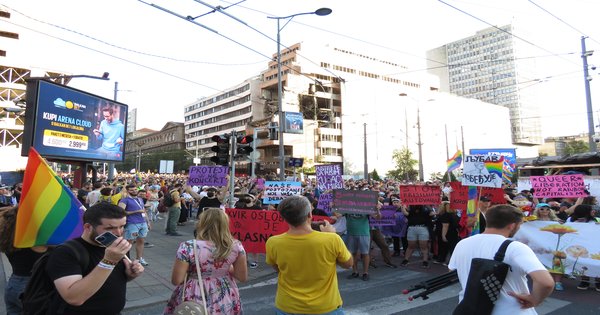
Istanbul Pride has been banned by the city’s governor every year since 2015. That hasn’t changed in 2026. What has changed is that the prosecutions against attendees and organisers — once mostly procedural — are now resulting in higher-profile, longer-running criminal trials. A trial against more than a dozen LGBTI leaders is currently in progress and has drawn international observers.
The Rainbow Map doesn’t grade Pride events directly, but it does grade civil society space — the freedom of LGBTI organisations to assemble, register, fundraise, and speak. Turkey scores essentially zero on that category. That’s how a country can have a population, a long pre-AKP history of LGBTI organising, and visible queer culture in its big cities, while still landing at 47th on a 49-country ranking.
Why this matters beyond Turkey
Turkey is a member of the Council of Europe. It’s a NATO member. It’s not currently moving on EU accession in any meaningful way, but it is a country whose treatment of LGBTI people is reviewed by the European Court of Human Rights on an ongoing basis. Several recent ECtHR rulings — including on Pride bans and on the registration of LGBTI organisations — have gone against Turkey. Compliance has been minimal.
There’s a pattern that the Rainbow Map is increasingly designed to catch: a country with formal democratic and rule-of-law structures uses those structures — courts, ministerial regulation, parliamentary procedure — to roll back rights without ever formally renouncing the framework. Hungary used this playbook for years before the European Court of Justice finally intervened. Russia abandoned the framework entirely. Turkey, the 2026 report suggests, is somewhere in between, with Erdoğan’s government using legal-procedural tools to do what an outright ban would do, but slower.
What to watch next
The next twelve months in Turkey are likely to include:
- A ruling on the appeal of the dissolved LGBTI youth organisation
- Continued criminal proceedings against the activists currently on trial
- Movement on the Parliament’s draft amendments to civil society law and the criminal code
- The 2026 Istanbul Pride ban, which is already in place, and the response of organisers
For people in the EU who follow this from a distance, the takeaway from the 2026 Rainbow Map isn’t only “Spain is doing well.” It’s that the gap between the top and the bottom of the European table is widening, and the country at the bottom that’s still officially Europe — still in the Council of Europe, still in NATO, still tied to the EU by a customs union — is the one moving in the wrong direction fastest.
The full Rainbow Map, with country-by-country breakdowns, is at rainbowmap.ilga-europe.org.