Belgrade Pride 2026 Will March in Solidarity With Serbia's Student Uprising
This year's Belgrade Pride is framing itself as a protest march first and a celebration second, joining forces with the student movement that has shaken Serbian politics since 2024.

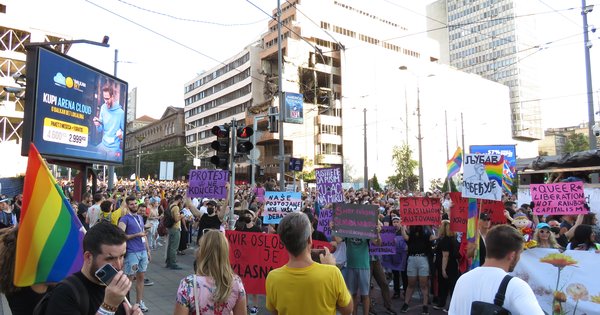
Belgrade Pride has announced that its 2026 edition — scheduled for September 6 in Manjež Park — will be a protest march first and a celebration second. For the first time, the organizers are explicitly aligning the march with Serbia’s student-led anti-government movement, which has been convulsing the country since late 2024.
“This year, Pride is a protest more than ever before,” Belgrade Pride stated in its call for event proposals, which opened this month. The organization pointed to a shared enemy: state violence. “The entire society is now confronted with police brutality on the streets of many Serbian cities, while members of the LGBTI+ community have been warning for decades that the police must equally protect all citizens.”
It’s a significant rhetorical shift — and a politically savvy one. By linking queer liberation to the broader democracy movement, Belgrade Pride is making the argument that LGBTQ+ rights aren’t a niche issue but a barometer for how a government treats all its citizens.
The student movement shaking Serbia
To understand why this matters, you need to understand what’s been happening in Serbia since November 2024. A catastrophic construction disaster at the Novi Sad railway station — which killed multiple people and exposed deep corruption in government contracting — triggered mass protests led primarily by university students.
What started as demands for accountability over the collapse evolved into something larger: a generational reckoning with President Aleksandar Vučić’s increasingly authoritarian rule. Students occupied university buildings. Hundreds of thousands marched in Belgrade and other cities. The government responded with force — more than 400 people were detained in early July 2025, with credible allegations of ill-treatment in custody.
Into 2026, the movement has persisted. It’s become the most sustained challenge to Vučić’s government in years, and it has broadened to include demands for press freedom, judicial independence, and free elections.
Why LGBTQ+ solidarity matters here
Serbia’s LGBTQ+ community knows what police brutality looks like. Belgrade Pride itself has a violent history — the 2010 march was met with riots by ultranationalist groups who attacked both marchers and police, injuring over 100 people. For years afterward, Pride was either banned or held under massive security lockdowns.
Things have improved since then. The 2024 edition was described as the “biggest ever,” and Belgrade’s queer community has steadily carved out more public space. But the underlying threats haven’t disappeared. Serbia still has no legal recognition of same-sex couples, and the Law on Same-Sex Unions that activists have demanded for years remains unpassed.
Belgrade Pride’s eight demands this year center on two legislative priorities: the adoption of the Law on Same-Sex Unions and the Law on Gender Identity. These aren’t new asks — they’ve been on the table for years. But by framing them within the context of a broader democratic crisis, Pride organizers are making a calculated bet that the student movement’s energy can be channeled toward LGBTQ+ rights too.
Cross-movement solidarity in the Balkans
This kind of coalition-building isn’t unprecedented in the region. Zagreb Pride, which turned 25 this year, has long positioned itself within Croatia’s broader human rights movement. And across the Western Balkans, LGBTQ+ organizations have increasingly found common cause with feminist groups, anti-corruption activists, and media freedom advocates.
The logic is straightforward: in countries where democratic institutions are weak, the people who get targeted first are the ones with the least political power. LGBTQ+ communities, ethnic minorities, independent journalists — they all face variants of the same problem. Building alliances isn’t just morally right; it’s strategically necessary.
ERA – LGBTI Equal Rights Association, which coordinates queer organizations across the Western Balkans and Turkey, has been pushing this kind of intersectional approach for years. Their work spans Albania, Bosnia & Herzegovina, Croatia, Kosovo, Montenegro, North Macedonia, Serbia, Slovenia, and Turkey — countries where the challenges vary in degree but not in kind.
What to expect in September
Belgrade Pride Week will run from September 1-7, with the main protest march on September 6 starting at 4 PM in Manjež Park. The organizers are currently accepting event proposals from individuals and organizations who want to participate in Pride Week programming.
Given the political climate, expect a heavier security presence than usual — and potentially a larger turnout. The student movement has mainstreamed the idea of public protest in Serbia in a way that benefits all social movements, including LGBTQ+ ones. If even a fraction of the students who’ve been marching against corruption show up for Pride, it could be a historic turnout.
For those of us watching from elsewhere in the Balkans, Belgrade Pride 2026 is worth paying attention to. Not because one march will change Serbian law overnight — it won’t. But because it represents something that’s been building across this region for years: the understanding that queer liberation and democratic freedom aren’t separate fights. They’re the same fight, and they’re stronger together.
Belgrade Pride is accepting event proposals at prajd.rs. Pride Week runs September 1-7, with the main march on September 6.