Vienna Pride 2026 Begins May 29 Under 'VISIBLE Since 1996' — Thirty Years of the Rainbow Parade
Vienna Pride opens May 29 with a Conference at the Rathaus and runs through the 30th Regenbogenparade on June 13. Three hundred thousand people are expected on the Ringstrasse. Here is what the program looks like and why the anniversary framing matters.
Vienna Pride 2026 opens Thursday, May 29 with the Pride Conference at Vienna City Hall and runs for sixteen days through the 30th Rainbow Parade — the Regenbogenparade — along the Ringstrasse on Saturday, June 13. The official slogan this year is VISIBLE seit 1996, “Visible since 1996,” and the number on every poster is 30. The organizing host, HOSI Wien, is leaning hard on the anniversary framing, and once you understand what 1996 actually meant in Austria, the framing makes sense.
Why 1996 is the date on the poster
The first Vienna Rainbow Parade marched on June 29, 1996. Austria had decriminalized homosexuality in 1971, but a separate criminal-code provision, paragraph 209, had kept the age of consent for same-sex relations between men at eighteen — four years higher than for opposite-sex relations — and was not struck down by the Constitutional Court until 2002. In 1996 you could still be prosecuted under 209. The first Rainbow Parade was, by design, an act of legal defiance as well as a celebration. It drew somewhere around 25,000 people, which was a startling number for the time and for the city.
The 2026 march is expected to draw more than 300,000, twelve times that figure. The framing of VISIBLE since 1996 is not just a nostalgia exercise. It is a way of asking, deliberately and on every poster, how a thirty-year arc of public LGBTQ+ visibility actually moves a country — what changes, what does not, and what changes more slowly than the posters might suggest.
The program: sixteen days, more than a hundred events
Vienna Pride is one of the longest Pride programs in Europe by calendar length. The 2026 schedule, as published by viennapride.at, runs from May 29 through June 14 and includes more than a hundred officially listed events across the city. The headline anchors:
The Pride Conference at the Rathaus (Vienna City Hall) on May 29 opens the program with a policy-focused day on hate-crime data, trans healthcare access in Austria’s federal system, and the implementation of the EU’s LGBTIQ+ Equality Strategy 2026–2030. The conference is free with registration and runs in German and English.
The Vienna Pride Community Fest and Pride Vienna Run on the Prater Hauptallee on May 30 turn the Prater into the city’s main Pride hub for the day, with community organizations, LGBTIQ+ artists, food and a charity run that has, in recent years, drawn around two thousand participants.
A run of mid-week events — Drag Beach on June 4, the Pride Happening at the Badeschiff on June 6, the Pride Beach Day on June 7 — anchor the weekend stretches before the parade.
The Pride Village on Rathausplatz opens for the final weekend and stays open through the parade itself on June 13, with a diverse stage program, food, and drink stretching from the steps of the Rathaus to the Burgtheater.
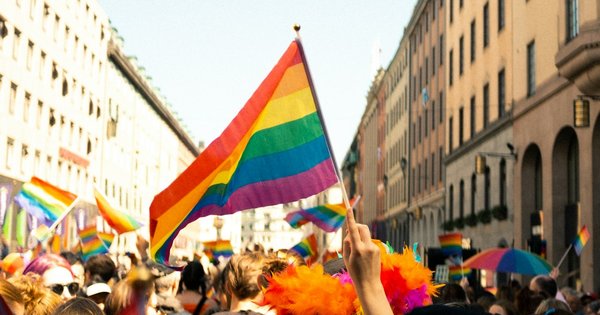
The 30th Regenbogenparade on Saturday, June 13 is the centerpiece. The route runs counter-clockwise around the Ringstrasse — the Habsburg-era boulevard that loops the historic city center — for roughly four and a half kilometers, with floats from political parties, embassies, unions, queer organizations, and corporate sponsors. The parade has, since the 2010s, been one of the largest LGBTQ+ events in Central Europe by participation; 2026, with its anniversary weight and Austria’s relatively unsettled political climate, is expected to be one of the largest in the parade’s history.
What the anniversary framing actually does
Three things to watch in how Vienna 2026 frames itself.
The first is that VISIBLE since 1996 is, deliberately, not a celebratory slogan. The German phrasing — sichtbar seit 1996 — has a present-tense edge to it. It asserts that visibility is an ongoing fact, not an accomplishment to be marked. The organizers we have read interviewed about the choice have been explicit that the 30-year anniversary is not a victory lap. Austria’s far-right Freedom Party (FPÖ) is in coalition government as of January 2025 and has, predictably, sharpened its rhetoric on what it calls “gender ideology” in education and in public broadcasting. The march will be marching past, and into, that political reality.
The second is that the anniversary lets Vienna do something most Pride programs cannot, which is build a serious historical strand into a week that is usually dominated by parties and parade logistics. There are at least four exhibitions across the program — at the Wien Museum, at the QWIEN queer archives, at the Volkstheater, and at the Sigmund Freud Museum — that document Vienna’s queer history through, against, and outside the official narrative of Austrian LGBTQ+ rights. QWIEN’s program in particular is worth a half-day if you have the time; the archive holds the most comprehensive collection of pre-1971 Austrian queer ephemera in the country.
The third is the political symbolism of the route. The Ringstrasse was built in the 1860s and 1870s, on the order of Emperor Franz Joseph, as a deliberate replacement for the medieval walls of the inner city. The boulevard was supposed to make the city legible, modern, European, and bourgeois. Marching it as a queer parade — counter-clockwise, with 300,000 people, past the Parliament and the Burgtheater and the Hofburg — is a particular kind of claim about what European, modern, and legible mean in 2026. The 30-year-old version of that claim landed differently in 1996. It lands differently again now.
If you are going
The Wednesday-to-Saturday stretch from June 10 to June 13 is the densest part of the program; hotel prices double for those nights. The U-Bahn is free for ticket holders on parade day with the Pride wristband. The official hub is the Vienna Pride website, which carries the day-by-day calendar; HOSI Wien’s news page carries the political context.
If you are coming from outside the EU, Austria is in the Schengen Area, so the same 90-in-180 calculation applies as for any other Schengen country. If you have been in the Balkans through May, you have not been burning Schengen days, and Vienna in mid-June is one of the best ways to use them.
We are not making it to Vienna ourselves this year; we are in Tirana for Tirana Pride this weekend and on the road for the rest of June. But Vienna Pride 2026 is, by any reasonable measure, the biggest Pride event in Central Europe this year, and if you are within a train ride of it, it is worth being there for the 30th.