LGBTQ+ Travel Guide to Belgrade, Serbia: What to Know Before You Go
Belgrade has one of the most vibrant queer communities in the Balkans, with a growing Pride Week and a creative underground scene. Here's what LGBTQ+ travelers need to know about visiting Serbia's capital.

We’ve spent a lot of time talking about Tirana — our home base in the Balkans, the city we return to again and again. But the Balkans is a region, not a single city, and Belgrade is one of its most compelling. Serbia’s capital sits at the confluence of the Sava and Danube rivers, carries centuries of layered history in its streets, and pulses with creative energy that doesn’t fit neatly into any European category.
It also has one of the most active and visible LGBTQ+ communities in the entire Balkans.
The Honest Context: Serbia’s Political Reality
We write about the Balkans with the belief that honesty serves travelers better than either alarm or reassurance. So here’s the honest picture for Belgrade.
Serbia has meaningful legal anti-discrimination protections: sexual orientation and gender identity are protected categories in employment, education, media, and housing. A draft civil union bill has been in play in parliament, and public polling consistently shows 73-80% of Serbs support some form of legal recognition for same-sex couples. The LGBTQ+ community in Belgrade is organized, vocal, and growing.
At the same time, the Serbian government has blocked any partnership legislation. President Vučić has explicitly stated he won’t support a civil union law before his term ends in 2027. Outside Belgrade, LGBTQ+ life can be significantly more difficult — a planned 2025 Pride event in Kruševac was effectively shut down by mob threats and police inaction.
Belgrade specifically is meaningfully different from the rest of Serbia. This is a pattern across the Balkans: the capital cities (Tirana, Sarajevo, Skopje, Pristina) tend to be significantly more open than the surrounding country. Traveling to Belgrade is not the same as traveling to rural Serbia, and LGBTQ+ visitors should be aware of that distinction.
Belgrade Pride: September 1–7, 2026
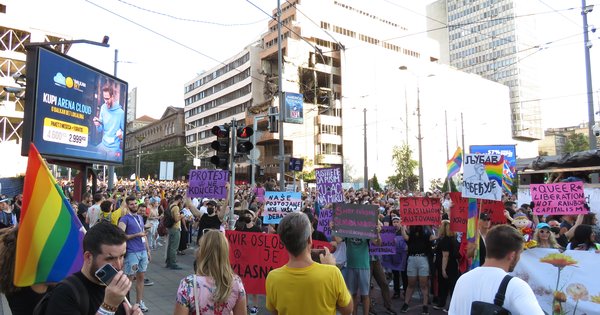
The centerpiece of Belgrade’s LGBTQ+ calendar is Belgrade Pride Week, which in 2026 runs September 1–7. The parade itself takes place on Saturday, September 6, starting at 16:00 from Manjež Park.
Belgrade Pride has grown consistently over the past decade. The 2024 march was described as the biggest ever, and the 2025 event was notably connected to Serbia’s broader pro-democracy movement — marchers explicitly linked LGBTQ+ rights to the political struggle following the Novi Sad train station disaster. The march has a reputation for energy, solidarity, and a genuinely diverse crowd.
Pride Week includes cultural events, workshops, panel discussions, parties, and a live concert as the closing event. If you can time a Belgrade visit for early September, it’s worth doing.
Where to Be: Savamala and Beyond
Belgrade’s most LGBTQ+-friendly neighborhood is Savamala, the riverside arts and nightlife district that runs along the Sava waterfront south of the old city. Savamala hosts a dense concentration of bars, clubs, galleries, and creative spaces. It’s where you’re most likely to encounter openly queer nightlife and feel completely comfortable.
The wider Dorćol neighborhood, just northeast of the fortress, is another area with a liberal, creative character — independent coffee shops, bookstores, and arts venues.
For nightlife specifically, Belgrade has a reputation for extraordinary club culture: boats moored on the river that transform into clubs, sprawling warehouse spaces, and venues that run until morning. The LGBTQ+ scene has significant presence within Belgrade’s broader club world, particularly in Savamala venues. Ask locally or check Belgrade Pride’s social channels for current venue recommendations, as the scene evolves quickly.
Day-to-Day Experience
Within the central city and Savamala, same-sex couples walking together or showing affection should generally feel comfortable. We haven’t spent as much time in Belgrade as we have in Tirana, but every visit has been unremarkable in the best sense — the city has too much going on for anyone to pay much attention to who you’re with.
The calculus shifts in more conservative neighborhoods, particularly in outer districts or at major sports venues. Using standard urban travel judgment — reading the environment, being more reserved in contexts where you’re clearly the only foreign visitors — applies here as it does in many cities.
Trans and gender-nonconforming travelers may find Belgrade more variable than cisgender gay or lesbian visitors. The broader social environment is more conservative on gender expression, and the lack of legal recognition means official contexts (hotels, some institutions) can be awkward in ways that legal frameworks would otherwise prevent.
Practical Notes
Getting there: Belgrade’s Nikola Tesla Airport (BEG) has direct connections across Europe. The city center is about 20 minutes by taxi. Bolt and Car:Go work well for app-based rides.
Getting around: Belgrade is very walkable in the center. Public transit is functional. Taxis are cheap by Western European standards; agree a price or use a metered cab.
Accommodation: Hotels in Belgrade are generally professionally run and not an issue for same-sex couples. We’d default to Savamala or Dorćol for neighborhood vibe, or near the Knez Mihailova pedestrian street for central access.
Language: Serbian uses Cyrillic script in formal contexts, but Latin script is widely used and most younger Belgraders speak at least basic English. Learning a few words of Serbian (hvala — thank you, dobar dan — good day) is appreciated.
Cost: Belgrade is very affordable by Western European standards. A solid dinner for two with wine runs €20-30. Coffee is under €2. A central apartment for a month can be found for €500-800 depending on timing.
Our Overall Take
Belgrade is one of the most interesting cities we’ve visited in the Balkans — underrated, complex, impossible to summarize. The LGBTQ+ community there is doing real work in difficult conditions, and the city itself rewards the kind of curious, open-minded travel we find most satisfying.
Come in September if you can, and catch the Pride march. The rest of the year, Savamala at night and the Kalemegdan fortress at sunset will do just fine.
Sources: Belgrade Pride (prajd.rs); Balkan Insight; Equaldex Serbia; our own visits.