LGBTQ+ Travel Guide to Bucharest: Quietly Queer, Cheaper Than You Think
We've been twice — once in 2015, again as nomads in 2022 — and Bucharest has changed faster than the headlines suggest. Romania's capital is an underrated long stay for queer travelers who want a real city, real food, and breathing room from the usual European circuit.

We’ve been to Bucharest twice — first in 2015 on a long Eastern European loop, again in 2022 as full-time nomads who needed a reasonably-priced base for a month between Cyprus and Athens. Both times we left thinking the city is significantly underrated by queer travelers, and both times we came back with the same observation: most of what’s written about Bucharest as a gay destination is either ten years out of date or written by someone who flew in for Pride and flew out the next morning.
Here’s our actual read on it, with the honest caveats.
What’s changed since the last guidebook update
The legal picture in Romania is the part most outdated guides get wrong. As of mid-2026, Romania still has not legislated civil unions for same-sex couples, despite the European Court of Human Rights ruling in Buhuceanu v. Romania in 2023 that the country was in violation of its obligations. Three years on, Bucharest has not yet complied. We covered the noncompliance question in our recent reporting on the ECHR ruling — the short version is that Romanian queer couples remain in legal limbo.
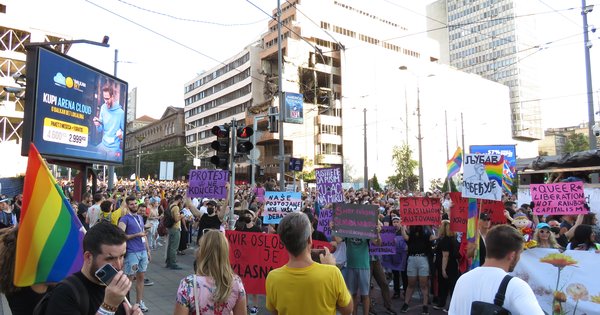
What has changed is the social temperature. Bucharest Pride has grown every year since 2018. The 2025 march, the 20th anniversary, drew the largest crowd in the event’s history — somewhere between 25,000 and 30,000 people walking the route, with foreign embassies (we noticed Spain’s especially) putting their flags out and joining in. The 2026 edition runs in June, with the date and details still being finalized as of early May.
The day-to-day texture of the city for queer visitors is much warmer than the legal framework suggests. We held hands in the Old Town at night both visits and never had a problem. Verbal harassment exists; we’ve heard about it from friends. We didn’t personally experience it. Your mileage may vary, particularly outside the central tourist zones.
Where to base yourself
Bucharest doesn’t have a designated gay neighborhood the way Barcelona has the Eixample or Madrid has Chueca. The closest thing to a queer center of gravity is Centrul Vechi (the Old Town) and the streets just north of it, around Piața Universității and the Lipscani area. That’s where the bars are, where most of the cafés we liked were, and where you’ll spend most evenings if you’re here for more than a long weekend.
If you’re staying a month or longer (we did, in 2022), we’d actually recommend looking slightly outside the immediate Old Town — places like Cotroceni, Dorobanți, or the streets around Cișmigiu Gardens. The Old Town gets loud on weekends, and prices on monthly apartment rentals drop noticeably the moment you cross out of the immediate tourist zone. We found a one-bedroom in a beautiful interwar building on a quiet street near Cișmigiu for about half what an Old Town apartment would have cost.
Hotels and Airbnbs across the central districts are queer-friendly in our experience. We’ve never had an awkward check-in moment with a one-bed reservation. The boutique hotels in the Old Town in particular tend to draw a young, international clientele.
The bars and clubs
Queens Club is the long-running gay nightclub. It’s in the Old Town, runs drag shows, and packs the floor on weekends. The crowd is mixed — heavy on locals, with foreign visitors picking up during Pride and summer. Music is mostly pop and dance. It’s not pretending to be Berlin and that’s fine.
Control Club is technically not a gay bar but is the queer-friendliest alternative venue in the city. Live music, indie crowd, frequent queer parties. We had some of our best nights there both visits.
The Drunken Lords pub crawl that runs out of the Old Town has a noticeably mixed crowd and friendly staff if you’d rather start with a bar crawl than a club. We’re not pub-crawl people, but we did this once with a group of queer travelers in 2022 and it was painless.
For more low-key evenings, the cafés on Strada Smârdan and around Pasajul Macca-Vilacrosse are uniformly relaxed and queer-comfortable. We worked from M60 (a mixed café-coworking spot near the Old Town) for most of our 2022 stay.
Food and the parts of the city we keep recommending
We have strong opinions about Romanian food. The case for Bucharest as a long stay rests heavily on the food being significantly better and significantly cheaper than most European capitals will give you for the same price.
Caru’ cu Bere is a tourist institution and worth doing once, ideally for a late lunch when it’s quieter. For better food and lower prices, our regulars in 2022 were Lente (excellent modern Romanian, hidden in Cotroceni), Hanu’ lui Manuc (touristy but the courtyard alone justifies it), and a tiny place called Zexe Zahana on Strada Doamnei that does old-school Romanian small plates we still talk about.
Bucharest’s wine and craft cocktail scenes are both well above what we expected. Romania makes some genuinely good wine, much of which never leaves the country. Try a fetească neagră.
Pride 2026 timing
Bucharest Pride typically falls in mid-June, with a full week of programming leading up to the march. If you’re routing through Eastern Europe in June, it’s a strong candidate week. We’ll update this with confirmed 2026 dates once Asociația ACCEPT publishes them.
Plan around the march, not just for it — the surrounding events (panels, exhibitions, smaller parties) are where we made friends both times. The march itself is moving and well-protected, but the rest of the week is where the actual community is.
Practical notes from our two stays
Bucharest is one of the cheaper European capitals to live in. In 2022 our monthly burn rate was lower than it had been in Tirana — a sentence we did not expect to write before we got there. Fast internet, abundant coworking, and a proper international airport with budget connections to most of Europe make it a strong nomad base.
The metro is excellent and cheap. Taxis (use Bolt or Uber, not street taxis) are plentiful. The walking is good in the center; less good in the more brutalist outer districts. Pharmacies are everywhere and English is spoken in most of them. The PrEP availability in Romania is improving but still lags Western Europe — bring what you need or arrange ahead through a local provider before you go.
Schengen status: Romania is now in the Schengen Area for air and sea travel as of 2024 and for land travel as of 2025. For our fellow nomads counting Schengen days, that matters. Romania now eats your 90-in-180 like everywhere else in the zone, so plan accordingly.
Why we keep recommending it
There are flashier queer destinations in Europe. Madrid is sunnier, Berlin is wilder, Vienna is more polished, Amsterdam is more Pride-flag-on-every-balcony. Bucharest doesn’t compete with any of them on those terms.
What it offers is something else: a real, ordinary, livable European capital where the queer life is quieter, the rent is reasonable, the food is excellent, and the city is far enough off the beaten queer track that you can have it largely to yourself for the cost of a long flight from somewhere louder.
That’s our case for it. We’ll be back.