LGBTQ+ Travel Guide to Skopje, North Macedonia: Small Scene, Big Heart
North Macedonia's capital is on our list — and after four years in the Balkans, we've done the homework. Here's what LGBTQ+ travelers should know about Skopje before they go.

We haven’t made it to Skopje yet — but it’s on the list. After four years living across the Balkans (Tirana, Sarandë, Athens, Sofia, Bucharest, and more), we’ve spent a lot of time talking to people who have, reading up on the queer scene there, and watching North Macedonia’s slow, uneven progress on LGBTQ+ rights from neighboring countries.
North Macedonia is one of those Balkan countries where the legal framework says one thing and the social reality says something else, and Skopje sits right at the center of that contradiction. Here’s what we’ve gathered — and what you should know before you go.
The legal landscape
North Macedonia decriminalized homosexuality in 1996, and in 2019 passed an anti-discrimination law that explicitly includes sexual orientation and gender identity as protected categories. On paper, that’s more progressive than some of its neighbors.
In practice, there’s no legal recognition of same-sex couples — no marriage, no civil unions, no registered partnerships. Adoption by same-sex couples is not permitted. Legal gender recognition exists but requires a complex, often opaque bureaucratic process. ILGA-Europe ranked North Macedonia 31st out of 48 European countries for LGBTQ+ rights in 2024.
The country has been an EU candidate since 2005 — one of the longest-running candidacies in the bloc’s history — and LGBTQ+ rights remain one of the areas where Brussels has pushed for progress.
The vibe on the ground
Skopje is not a city where you’ll see rainbow flags in shop windows or same-sex couples holding hands on the main square. It’s conservative in the way many Balkan cities are: people are generally polite and hospitable, but queerness is treated as something that exists in private, not in public.
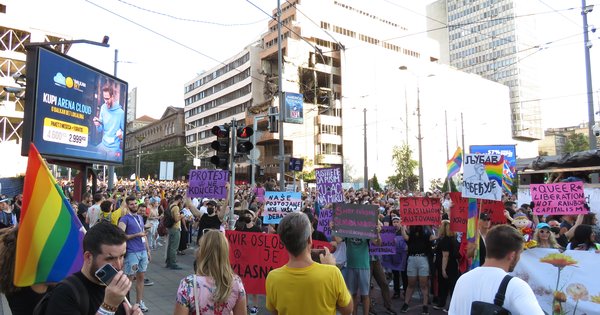
That said, younger Skopjans — especially in the creative and university circles — are increasingly open. The city has hosted Skopje Pride every June since 2019, and attendance has grown from about 1,000 to several thousand. The 2025 march went off without major incident, which is not something you could have assumed a decade ago.
From what we’ve heard from queer friends and fellow travelers who’ve been, the experience for a visibly gay couple is similar to what we’ve found in Sofia or Bucharest — generally uneventful, as long as you read the room in more conservative settings.
Where to go
The queer-friendly scene in Skopje is small but real. Here’s what consistently comes up:
Debar Maalo neighborhood — This is the neighborhood you want. It’s Skopje’s creative and bohemian quarter, packed with cafes, wine bars, and art galleries. The crowd skews young, progressive, and artsy. Think of it as Skopje’s answer to Blloku in Tirana — just smaller.
Club Epicentar — The closest thing Skopje has to a dedicated gay bar. Strong cocktails, good music, and a crowd that’s explicitly welcoming. It’s not exclusively LGBTQ+, but it’s a recognized safe space.
Hotel Arka’s rooftop bar — A well-kept secret among Skopje’s queer community. The views are fantastic, the cocktails are solid, and the atmosphere is relaxed. It draws a mixed crowd, but the queer presence is understood.
Macca Bar — A stylish, chill spot that’s known for being welcoming to LGBTQ+ visitors. Good for a low-key evening drink.
Old Bazaar (Čaršija) — Skopje’s Ottoman-era bazaar is worth exploring for the architecture, the food, and the atmosphere. It’s more conservative than Debar Maalo, so keep the PDA to zero here, but it’s a fascinating part of the city.
Where to stay
If we were booking, we’d look for an Airbnb in Debar Maalo. The neighborhood is walkable, the restaurants are right outside your door, and you’re close to everything. If you prefer a hotel, Hotel Arka and Hotel Solun are both centrally located and consistently reviewed as LGBTQ+-friendly.
Skopje is remarkably affordable — even by Balkan standards. Listings we’ve seen put one-bedroom apartments under €30 a night, and from what friends tell us, dinner for two with wine rarely exceeds €20.
Safety
We won’t sugarcoat this: North Macedonia is still a conservative society, and homophobia exists. A 2019 survey found that the country ranked among the worst in Europe for LGBTQ+ acceptance. Hate speech laws exist but are weakly enforced. Violence against LGBTQ+ people is underreported.
The practical advice we’d give — the same we follow everywhere in the Balkans:
Be yourself, but read the room. Debar Maalo and the university area are relaxed. Other neighborhoods — especially outer suburbs and smaller towns — are less so. Avoid public displays of affection in unfamiliar areas after dark. Use common sense, the same way you would in any Balkan city.
If you’re a same-sex couple checking into a hotel or Airbnb, you’re unlikely to encounter problems. The hospitality industry in Skopje is professional and increasingly accustomed to international visitors.
Getting there and getting around
Skopje Alexander the Great Airport (SKP) has budget flights from across Europe — Wizz Air operates routes to several hubs. The city center is a 20-minute taxi ride from the airport.
Within Skopje, everything in the center is walkable. Taxis and Bolt are cheap and reliable. If you’re doing a Balkans circuit — say, Tirana to Skopje to Belgrade — the bus connections are frequent and affordable, though not always comfortable.
The bottom line
Skopje isn’t a queer destination in the way Berlin or Barcelona is. It’s not going to make any list of the world’s best gay cities. But it’s a city that’s worth visiting for its own sake — for the bizarre, fascinating Skopje 2014 architecture, the Ottoman bazaar, the excellent Macedonian food, and the warmth of the people who live there.
And if you know where to look, there’s a queer community that’s building something real, in a place where that takes courage. We think that’s worth showing up for.
Skopje Pride 2026 is scheduled for June 20. If you’re in the region, consider timing your visit accordingly.