Skopje Pride 2026 Heads Toward June With a New EU Backdrop and an Old Domestic Argument
North Macedonia's Pride march is now in its eighth year and is increasingly entangled with two questions the country has not resolved: EU accession and the place of religious-conservative parties in a coalition government.
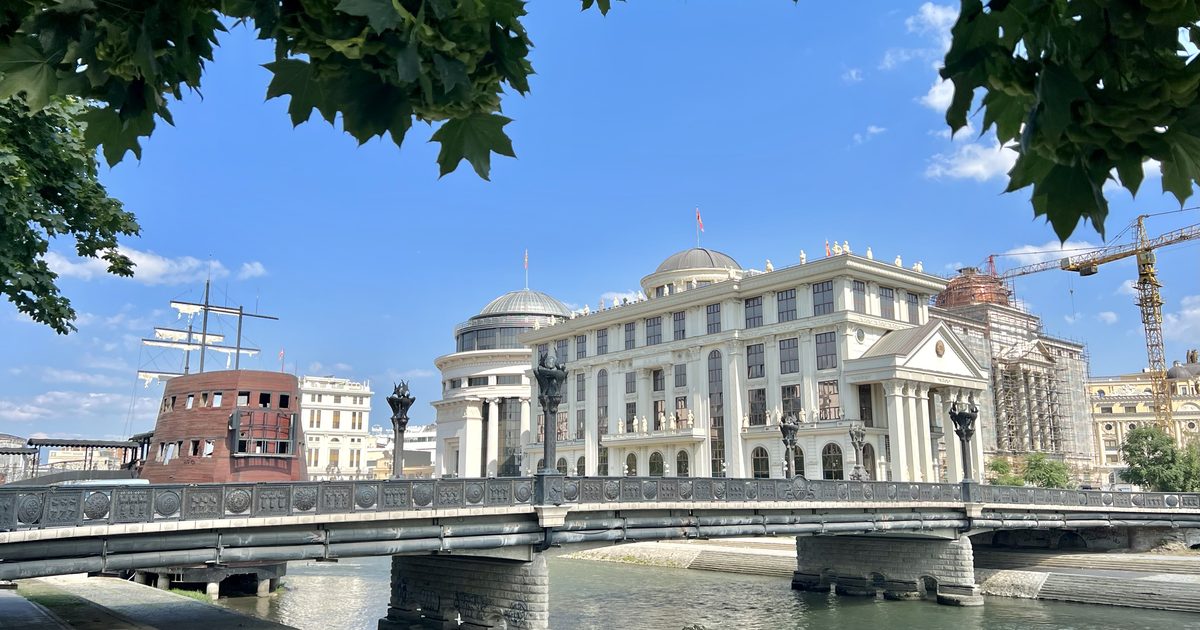
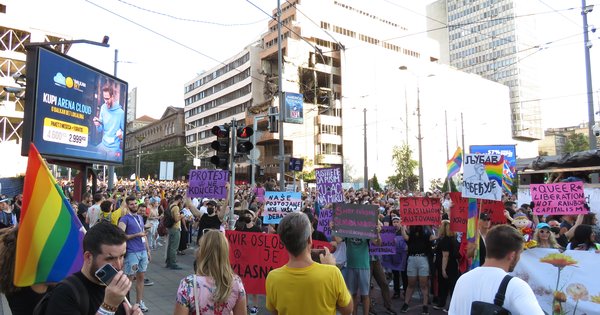
Skopje Pride is now in its eighth year. The first march, in 2019, brought a few hundred people through central Skopje under unusually heavy police protection and with a coalition of foreign embassies — the EU delegation, the U.S., the U.K., the Netherlands, Germany — visible at the front of the crowd. Last year’s march drew around 2,500. The 2026 edition, scheduled for late June, will take place against a political backdrop that has shifted in ways large and small since the country last paraded.
The headline shift is EU accession. North Macedonia opened formal accession negotiations in 2022, after the long Bulgarian veto was lifted, and is now working through the cluster of chapters — fundamental rights, judicial reform, anti-discrimination — that historically determine whether a Balkan candidacy stalls or moves. The current center-right government, elected in 2024, has continued to support EU integration while loudly distancing itself from the cultural-policy implications of EU membership. Pride sits squarely inside that contradiction. The state will continue to provide protection for the march, partly because the alternative is an embarrassing scene in front of EU monitors. It will not, however, push the bills the country’s queer-rights movement has been asking for since 2018.
What the march is asking for this year
Skopje Pride’s published platform for 2026, posted to its website this month, names three legislative priorities. None of them are new. All three have been debated and shelved in the previous two parliaments.
The first is a same-sex partnership law. North Macedonia recognises neither marriage nor civil partnership for same-sex couples. A draft partnership bill has been circulated by Coalition Margins and the LGBTI Support Centre since 2022, and it has not been brought to a vote. The current ruling coalition includes a small religious-conservative party whose support is conditional on the bill not advancing.
The second is amendments to the Law on Prevention and Protection from Discrimination to add explicit references to gender identity and intersex characteristics. The current law covers sexual orientation but not gender identity, and the omission is one of the items flagged in the European Commission’s most recent enlargement report on North Macedonia.
The third is legal gender recognition. North Macedonia has no functional procedure for legal gender recognition. A 2019 European Court of Human Rights ruling against the country (X v. North Macedonia) ordered the government to introduce one. Six years later, no such procedure exists. The Council of Europe’s enforcement committee has flagged the case repeatedly. The 2026 Pride platform asks, in effect, that the government simply comply with a binding judgment it has been ignoring.
These are not maximalist demands. They are minimum-EU-compliance demands.
The political backdrop
North Macedonia’s politics, like the politics of most of the Western Balkans, are in a transitional moment. The current government holds a working majority that depends on a religious-conservative junior partner, which gives that partner outsized leverage on cultural-policy questions. Opposition parties — including the Social Democrats, who lost office in 2024 — are largely supportive of the LGBTQ+ platform but lack the votes to advance it. EU accession pressure is real but produces uneven results; the most active “Cluster 1” demands (rule of law, judiciary) are the ones the government is willing to move on, while “Cluster 5” demands on fundamental rights tend to drift.
For the march itself, this means the political weather is mixed but not hostile. Police protection is reliable. There has not been organised counter-violence at a Skopje Pride since 2019. The Macedonian Orthodox Church maintains a steady, rhetorical opposition to Pride that does not generally translate into mobilisation on the day. The far-right party Levica, which has campaigned against Pride in the past, has lost some of its visibility since the 2024 election. The risk environment for marchers, in other words, is closer to that of Belgrade or Tirana than to that of Sofia or Bucharest.
Where Skopje Pride sits in the regional calendar
For travellers piecing together a Balkans Pride circuit this summer, Skopje fits between Tirana (May 23) and Belgrade (early September), with Athens (June 13) sitting on the Western flank and Zagreb (June 7) on the Northwestern. We have not made it to Skopje ourselves yet. Friends who have describe the march as smaller than Belgrade, friendlier than Sofia, and closer in feeling to Tirana — meaning a Pride that is still primarily a political action rather than a primarily celebratory one, with afterparties and cultural programming layered on. The official programme runs five to seven days, includes film screenings and panel discussions, and culminates in the parade on the Saturday.
The march route in recent years has begun at Skopje’s central Macedonia Square, run along the Vardar River, and ended at the City Park. It is a short walk by Pride standards, perhaps two kilometres, deliberately routed past the institutions Pride is trying to address: parliament, the constitutional court, and the prime minister’s office.
What to watch between now and June
Three things will tell us how the 2026 march goes. First, whether the European Commission’s enlargement report — due in the autumn but trailed in spring — explicitly names the same-sex partnership law and gender-recognition procedure as outstanding accession items. Second, whether the religious-conservative coalition partner attempts to use the march itself as a wedge issue, as it did briefly in 2024. Third, whether the parliamentary opposition tables either of the two long-shelved bills as a political marker, even without the votes to pass them.
Skopje Pride will happen either way. It happens every year now. The interesting question is whether 2026 is the year it stops being purely symbolic.