LGBTQ+ Travel Guide to Pristina, Kosovo: Quiet, Complicated, and Worth Your Time
Pristina is one of the youngest capital cities in Europe — and one of the most overlooked by queer travelers. Here's what to know about scene, safety, and the political context you'll be walking into.
We haven’t made it to Pristina yet — it is near the top of our Balkans list for late 2026 — so consider this a researched guide rather than a lived one. It draws on conversations with travelers and activists who do know the city, on reporting from ERA-LGBTI and the Center for Social Group Development (CSGD), and on what we’ve found holds true more broadly across the Western Balkans: that the gap between what a country’s laws say and what its streets look like is usually wider than the press coverage suggests.
Kosovo is the youngest country in Europe — sovereign since 2008 — and Pristina is its capital, its cultural center, and its most LGBTQ+-visible place by a significant margin. If you are rotating through the Balkans and have already done Tirana, Skopje, and Belgrade, Pristina is the obvious next stop. It is also the one that most travelers skip. That is worth correcting.
The legal landscape, briefly
Kosovo’s constitution explicitly prohibits discrimination on the basis of sexual orientation. It is one of only a handful of constitutions globally that does so. On paper, this puts Kosovo ahead of several EU member states. In 2015, Kosovo’s Law on Protection from Discrimination added sexual orientation and gender identity as protected characteristics. In 2019, a revised Civil Code draft proposed civil partnerships for same-sex couples — and that is where the ambition has stalled.
As we reported in April 2026, the civil partnership provisions have been dropped, reinstated, and dropped again as the Civil Code has moved through Kosovo’s Assembly. The current government has not prioritized it. Kosovo recognizes same-sex relationships neither as marriages nor as registered partnerships.
The practical result: a legally LGBTQ+-friendly framework with real anti-discrimination enforcement on paper, sitting on top of a socially conservative, majority-Muslim society in which most queer people are still not out to their families.
What Pristina is actually like
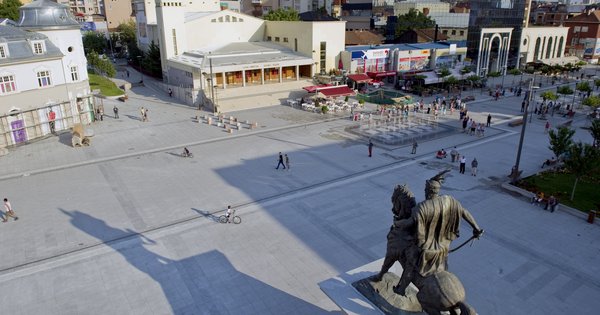
The city is small. Roughly 200,000 people in the city proper, walkable end to end in 45 minutes. The main pedestrian boulevard, Nënë Tereza (Mother Teresa) Boulevard, is the social spine of the city. Cafés are everywhere and cheap. The coffee culture rivals Tirana’s.
Pristina does not have gay bars in the traditional sense. There is no Blloku equivalent. What it has is a network of friendly, queer-aware cafés and bars — mostly clustered in the Qafa and Ulpiana neighborhoods — where same-sex couples report being comfortable, though not flamboyantly out. Hookup apps work the same as anywhere in the region; expect a smaller grid than Tirana or Skopje, with a lot of travelers and a lot of discreet profiles.
Nightlife: Queer-friendly venues rotate. The longest-running reference point has been Bubble Pub, and a handful of underground parties organized by CSGD and Center for Equality and Liberty (CEL) happen several times a year — usually publicized via Instagram a few days ahead.
Culture: DokuFest (documentary film festival) in nearby Prizren in August regularly programs queer-themed films. Pristina International Film Festival (PriFest) does the same in spring. Both are worth timing a trip around.
Food: Kosovar food is lamb-heavy, bread-heavy, and excellent. Try Soma Book Station for a café-bookstore vibe that skews progressive, Renaissance for traditional, and Salute for something closer to Western European bistro cooking.
Pride and visible community
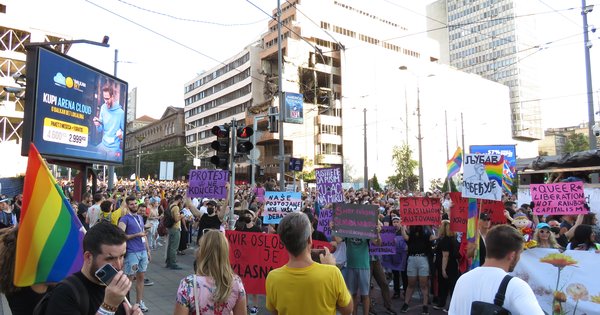
Pristina Pride has run since 2017. The march typically takes place in October — not June, which is both a scheduling quirk and a nod to political timing around the start of the legislative year. Turnout has grown from a few dozen in 2017 to several hundred, with strong support from EU diplomatic missions and a permissive-but-watchful police presence. It is not Belgrade Pride’s scale, but it is not a symbolic walk either.
The organizers to know are CSGD and CEL. Both are small, both are underfunded, and both are the reason the city has any public LGBTQ+ life at all. If you are a journalist, activist, or researcher passing through, reaching out in advance is easy and welcome.
Safety: the honest version
Kosovo is not Tirana-level comfortable for queer travelers, and it is not Belgrade-dangerous either. Reports from travelers and from the 2025 ILGA-Europe Rainbow Map consistently describe Pristina as “cautious but safe” — meaning you are unlikely to experience direct harassment, but public same-sex affection (hand-holding, kissing) is still uncommon and can draw stares, particularly outside the central pedestrian streets.
The one area where travelers should be specifically alert is hookup apps. Kosovo has had documented cases of app-based entrapment and blackmail, more often targeting local users than foreigners but not exclusively. Meet in public first. Tell someone where you’re going.
Trans travelers report a mixed picture. Kosovo recognizes gender identity in law but lacks clear administrative procedures for legal gender recognition. Healthcare access is limited; do not plan on routine trans healthcare access during a visit.
Getting there and staying
Pristina International Airport (PRN) has direct connections to most major European hubs (Vienna, Istanbul, Zurich, Munich, London Luton). Flights from Tirana are nonexistent for a country this close — the cheapest way between Tirana and Pristina is a 4–5 hour bus, which is actually a pleasant ride along the relatively new Tirana–Pristina motorway.
Accommodation is cheap by European standards. Airbnb and Booking both work. We have heard consistently good things about Hotel Prishtina, Swiss Diamond Hotel Prishtina (more business-oriented), and Hotel Sirius for location. Boutique options like Hotel Gracanica (just outside town, in the Serb enclave) offer a different angle on the region.
Kosovo uses the euro despite not being in the eurozone. ATMs are everywhere. English is widely spoken by anyone under 40, especially in central Pristina.
If you have two extra days
Take them. Prizren, two hours south, is the most beautiful city in Kosovo and a reasonable day trip — though staying overnight is better. Peja is the gateway to the Rugova Valley and hiking that rivals anything in the Albanian Alps. Gracanica Monastery, just outside Pristina, is a UNESCO World Heritage site and worth the 20-minute cab.
Why bother
It is a fair question. Pristina isn’t the easiest queer destination in Europe. It does not have the scene of Madrid or the comfort of Amsterdam or even the unexpected warmth we found in Tirana. What it has is significance: a small, serious, hard-working community holding a line in a country that is still figuring out whether it wants to be something different. Showing up as a queer traveler — even quietly, even just to spend money in the right places — is a political act here in a way it no longer is most of Western Europe.
If the Balkans are on your route, don’t skip it.